

Retail Display Light Fitting Repair: Restoring Safety and Presentation in a Premium Retail Environment

Case Study
Norwich, Norfolk
When a display light falls from the ceiling in a retail store, it creates immediate concerns that extend beyond simple maintenance. Customer safety, staff wellbeing, and brand presentation all demand prompt resolution. This case study details how All Services 4U responded to an urgent light fitting repair at The White Company's Norwich city centre store, restoring both safety and visual merchandising standards through efficient same-day repair.
image gen(1)

The Urgent Requirement

The White Company, a premium homeware and lifestyle retailer known for meticulous attention to store presentation, reported a light fitting that had come loose and was hanging from the ceiling at the front of their shop display area. In a customer-facing retail environment where visual merchandising is integral to the brand experience, this presented multiple concerns requiring prompt resolution.

A detached or partially-fallen light fitting in retail premises creates a cascade of issues. There is immediate customer safety risk from the potential for the fitting to fall further and cause injury. Staff working beneath unstable fixtures face ongoing safety concerns. The stressed wiring connections and potential cable damage represent an electrical hazard. The visual impact on store aesthetics affects customer experience and brand perception. Depending on the fixture’s location, there may be need to cordon off the affected area, directly impacting trading.

Under the Health and Safety at Work Act 1974, employers must ensure premises are safe for both employees and visitors. A loose ceiling fixture represents a clear hazard requiring immediate remediation, and responsible retailers like The White Company rightly treat such issues as priority callouts.

Site Assessment and Diagnosis

Our engineer attended the Norwich city centre location to assess the situation and implement a safe, permanent repair that would meet both safety requirements and the brand’s presentation standards.

Root Cause Analysis

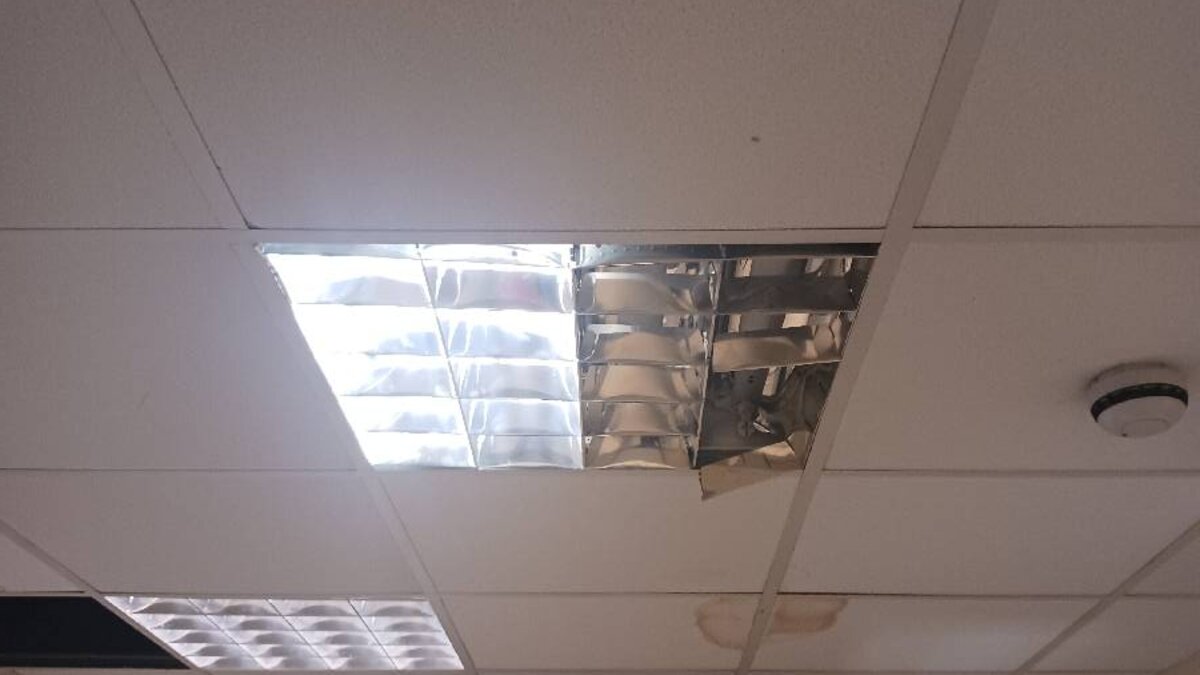
Upon examination, the engineer identified the failure mechanism. The light fitting had fallen at the front of the shop display area, where it served an important visual merchandising function. The original fixing screw had pulled out from the wooden ceiling surface, and the screw hole had become enlarged over time to the point where it could no longer support the fitting’s weight. Fortunately, the electrical connections remained intact, though they were under strain from the fitting’s partial displacement.

Understanding Fixing Failures

Light fittings can become detached for several reasons, and understanding these helps both in repair and in preventing future occurrences:

Failure Mode Cause Prevention
Substrate Degradation Wood drying out or becoming soft over time Regular inspection of fixing points
Vibration Building movement or nearby equipment Use of appropriate fixing types
Weight Stress Fittings at the limit of their fixing capacity Ensure fixings rated for load
Inappropriate Fixings Original installation using inadequate fasteners Correct fixing selection for substrate
Maintenance Access Repeated lamp changes weakening fixing points Care during routine maintenance

In this instance, the most likely cause was substrate degradation combined with the cumulative stress of normal use over time. The wooden ceiling had reached a point where the original fixing could no longer maintain purchase.
The Repair Solution

With the cause identified, the engineer implemented a robust repair designed to provide long-term security while meeting the aesthetic standards expected in a premium retail environment.

Repair Methodology

The first priority was establishing safe working conditions. The engineer isolated the lighting circuit at the appropriate point and secured the fitting to prevent further movement during work. The ceiling structure was then assessed to identify a suitable location for the new fixing point.

Rather than attempting to re-use the damaged fixing hole—which would have risked early re-failure—the engineer drilled a new hole in solid timber, offset from the damaged location. The new position was carefully selected to maintain correct fitting alignment while ensuring the fixing would engage with sound timber capable of supporting the load long-term.

The light fitting was re-mounted using the new fixing point, with all electrical connections verified as secure and undamaged. All fixings on the fitting were checked for tightness, and the circuit was re-energised for testing.

Verification and Handover

Final verification confirmed the fitting was secure with no movement under manipulation, the light operated correctly, and the repair met the visual presentation standards expected in the retail environment. The area was left clean and ready for trading, with no evidence of the repair work visible to customers.

Considerations for Retail Environments

Working in premium retail settings requires sensitivity to the brand environment and customer experience that goes beyond technical competence. The engineer understood that repairs must be effectively invisible—customers should never be aware that maintenance has occurred.

Balancing Competing Priorities

Retail repairs require careful balance across multiple dimensions:

Priority Consideration
Speed Returning display areas to full use quickly
Quality Repairs must be invisible or aesthetically acceptable
Disruption Work conducted with minimal impact on shoppers
Scheduling Working around peak trading periods where possible
Standards Meeting brand-specific presentation requirements

Premium retailers maintain strict visual merchandising standards, and any tradesperson working in these environments must understand that a technically sound repair is not sufficient if it leaves visible marks, misaligned fittings, or disturbed displays.

Ceiling Fixing Considerations

This case highlights a common issue in retail and commercial premises: the critical importance of correct ceiling fixings matched to both the substrate and the load.

Different ceiling constructions require different fixing approaches. Solid timber, as in this case, requires wood screws of appropriate gauge and length, with consideration for timber condition. Plasterboard ceilings require cavity fixings, toggles, or direct-to-joist mounting depending on the load. Suspended ceiling systems need grid-mounted fixtures or dedicated support wires independent of the ceiling tiles. Concrete soffits require appropriate anchors rated for the specific load.

Beyond static weight, light fittings must be secured to support dynamic loads from vibration or air movement from HVAC systems, stress from cable weight and routing, forces applied during maintenance access for lamp replacement, and an appropriate safety factor for unexpected loads.

Compliance and Documentation

The completed repair was documented with comprehensive photographic evidence showing the before condition with the fitting detached from the ceiling, the repair process including the new fixing location, the after condition with the fitting secure and operational, and overall appearance confirming retail presentation was restored.

This documentation supports the client’s compliance obligations by demonstrating prompt response to identified hazards, competent repair by qualified personnel, verification of safe and secure completion, and evidence for facilities management records and potential insurance requirements.

Multi-Trade Retail Support

This callout exemplifies the responsive service model that All Services 4U provides to retail clients and their facilities management partners. Our multi-trade capability makes us well-suited to retail estate maintenance, where a single contractor relationship simplifies management and ensures consistent service standards.

Capability Benefit
National Coverage Supporting retail estates across the UK
Rapid Response Priority attendance for safety and trading issues
Multi-Trade Teams Electrical, plumbing, carpentry and general maintenance
Brand Sensitivity Understanding of premium retail environments
Flexible Scheduling Working around trading hours as required
FM Integration Established processes with partners like CloudFM

For facilities managers, working with a single contractor for multiple trade requirements provides consolidated reporting and invoicing, consistent service standards across all work types, and simplified supplier management across distributed estates.

Proactive Maintenance for Retail

Rather than waiting for fittings to fail and create safety or trading issues, proactive inspection programmes can identify potential problems before they affect operations. Regular lighting inspections can assess fixture security alongside lamp condition and emergency lighting compliance. Combined with scheduled electrical testing and general fabric maintenance, such programmes protect both safety and brand presentation while reducing the disruption and cost of reactive callouts.


Service Category: Light Fitting Repair
Location: Norwich, Norfolk
Sector: Premium Retail
Client: The White Company
Resolution: Same-day repair, first-time fix
Reference: L4L-757310

All Service 4U Limited | Company Number: 07565878