

Smoke and Carbon Monoxide Policy
Protecting Lives Through Early Detection All Services 4U is committed to protecting residents from the dangers of fire and carbon monoxide poisoning. Smoke alarms and carbon monoxide alarms are critical life-safety devices that provide early warning and save lives. This policy sets out our procedures for the installation, testing, maintenance, and replacement of smoke and carbon monoxide alarms in compliance with current legislation. This policy applies to all smoke and carbon monoxide alarm work undertaken by All Services 4U on behalf of our clients.
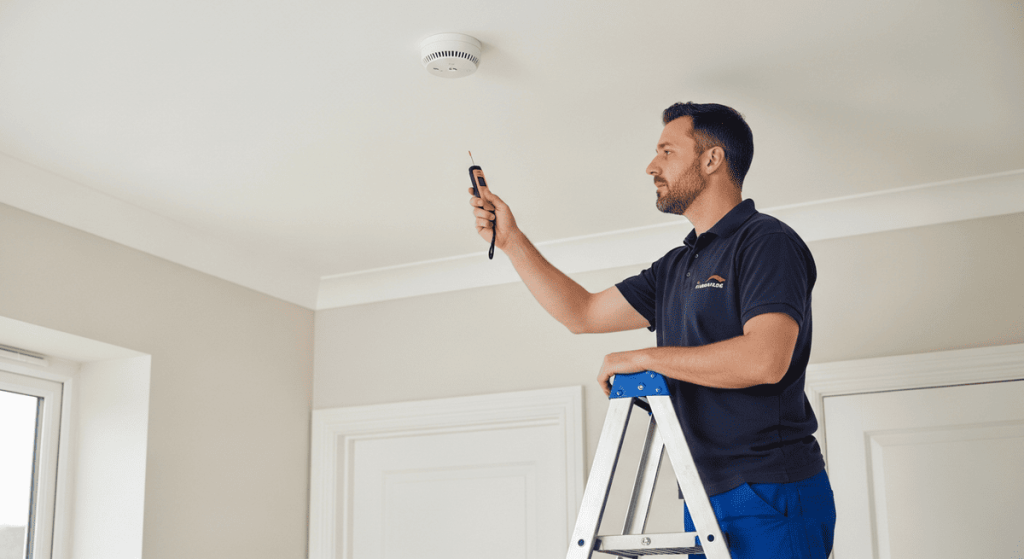
Our Commitment
We are committed to:
- Compliance — Meeting all statutory requirements for smoke and CO alarm provision
- Life Safety — Ensuring alarms are installed, working, and provide effective protection
- Quality — Installing alarms that meet relevant standards and specifications
- Reliability — Maintaining alarms to ensure they work when needed
- Responsiveness — Replacing faulty alarms promptly
- Documentation — Maintaining accurate records of all alarm work
- Education — Advising residents on alarm use and testing
Legal Framework
The Smoke and Carbon Monoxide Alarm (Amendment) Regulations 2022
These regulations apply to all rented properties in England (social and private) and require landlords to:
| Requirement | Details |
| Smoke alarms | At least one smoke alarm on each storey with habitable rooms |
| Carbon monoxide alarms | In any room with a fixed combustion appliance (excluding gas cookers) |
| Working condition | Alarms must be in working order at the start of each tenancy |
| Repair/replace | Landlords must repair or replace alarms once notified of a fault |
Regulatory Reform (Fire Safety) Order 2005
The RRO applies to common parts of residential buildings and requires:
- Suitable fire detection appropriate to the risk
- Maintenance in efficient working order
- Testing at appropriate intervals
- Documentation of testing and maintenance
Building Regulations Approved Document B
Specifies smoke alarm requirements for new builds and material alterations:
| Building Type | Requirement |
| New dwellings | Grade D1 LD3 system minimum (interlinked mains-powered with battery backup) |
| Material alterations | May trigger upgrade to mains-powered interlinked system |
| Loft conversions | LD2 system required (additional coverage of escape routes) |
BS 5839 Fire Detection and Fire Alarm Systems
| Part | Coverage |
| BS 5839-1 | Non-domestic premises |
| BS 5839-6 | Domestic premises — Code of Practice |
Other Relevant Legislation
| Legislation | Relevance |
| Housing Act 2004 | HHSRS includes fire as a hazard |
| Gas Safety (Installation and Use) Regulations 1998 | CO detection linked to gas appliances |
| Building Safety Act 2022 | Enhanced requirements for higher-risk buildings |
| Homes (Fitness for Human Habitation) Act 2018 | Alarms contribute to fitness for habitation |
Scope
This policy covers:
- All residential properties where we provide maintenance services
- Social housing, private rented sector, and leasehold properties
- Smoke alarms (ionisation, optical, heat, multi-sensor)
- Carbon monoxide alarms
- Combined smoke and CO alarms
- Domestic and communal detection systems
- Installation, testing, maintenance, and replacement
Smoke Alarm Requirements
Minimum Legal Requirement (Rented Properties)
At least one smoke alarm on each storey that contains a habitable room.
Habitable rooms include:
- Living rooms
- Bedrooms
- Kitchens (where used as living space)
- Studies
- Dining rooms
Non-habitable rooms (don’t count):
- Bathrooms
- Toilets
- Hallways (but alarms often best placed here)
- Landings
- Utility rooms
Best Practice Positioning (BS 5839-6)
| Location | Recommendation |
| Hallways | On each level, at top and bottom of stairs |
| Landings | Central position on escape route |
| Living rooms | Centre of ceiling, away from corners |
| Bedrooms | Centre of ceiling |
| Kitchen | Heat alarm preferred, or optical alarm >3m from cooking |
Where NOT to Install
| Location | Reason |
| Within 300mm of walls/corners | Dead air space |
| Within 300mm of lights/decorations | Airflow obstruction |
| Near air vents/fans | Airflow may prevent smoke reaching alarm |
| Bathrooms/shower rooms | Steam causes false alarms |
| Kitchens (ionisation alarms) | Cooking fumes cause false alarms |
| Garages | Vehicle fumes cause false alarms |
| Very dusty areas | Dust affects sensors |
| Near heating appliances | Heat affects sensors |
| On sloped ceilings (peak) | Dead air at apex |
Alarm Types
| Type | Technology | Best For | Avoid |
| Ionisation | Detects small particles (fast-flaming fires) | Bedrooms, living rooms | Kitchens, dusty areas |
| Optical (Photoelectric) | Detects larger particles (smouldering fires) | Hallways, landings, near kitchens | N/A |
| Heat | Detects temperature rise | Kitchens, garages | Sole protection (slow response) |
| Multi-sensor | Combined optical and heat | Any location | More expensive |
Power Supply Categories (BS 5839-6)
| Grade | Power Supply | Typical Application |
| Grade A | Fire alarm system to BS 5839-1 | HMOs, sheltered housing |
| Grade B | Mains-powered system with standby supply | Higher-risk domestic |
| Grade C | Mains-powered with no standby | Basic new build spec |
| Grade D1 | Mains-powered with battery backup | Standard new build (10+ years) |
| Grade D2 | Mains-powered without battery backup | Older new builds |
| Grade E | Primary battery (10-year lithium) | Existing properties |
| Grade F | Replaceable battery | Minimum standard (existing) |
Coverage Categories (BS 5839-6)
| Category | Coverage | Typical Application |
| LD1 | All areas including highest risk rooms | Enhanced protection |
| LD2 | Escape routes + high-risk rooms (kitchen, living room) | Loft conversions |
| LD3 | Escape routes only (hallways, landings) | Minimum standard |
Interlinking
Why interlink?
- When one alarm activates, all alarms sound
- Ensures residents are alerted wherever they are
- Essential for multi-storey properties
- Required for new builds and loft conversions
Interlinking methods:
- Hardwired (cable between alarms)
- Radio frequency (wireless)
- Hybrid (hardwired base units with RF link)
Carbon Monoxide Alarm Requirements
Legal Requirement (Rented Properties)
A carbon monoxide alarm must be installed in any room containing a fixed combustion appliance (excluding gas cookers).
Fixed combustion appliances include:
| Appliance | CO Alarm Required |
| Gas boilers | Yes |
| Gas fires | Yes |
| Gas water heaters | Yes |
| Oil boilers | Yes |
| Oil fires | Yes |
| Solid fuel fires (open fires) | Yes |
| Wood burners | Yes |
| Coal fires | Yes |
| Gas cookers/hobs | No (excluded) |
| Portable heaters | No (not fixed) |
Positioning
| Requirement | Specification |
| Height | 1-3 metres from floor (CO mixes with air) |
| Distance from appliance | 1-3 metres horizontally |
| Ceiling mounting | At least 300mm from any wall |
| Wall mounting | At least 150mm from ceiling, above any door/window |
| Not behind furniture | Must be visible and accessible |
| Not in enclosed space | Must be in open room air |
Where NOT to Install
| Location | Reason |
| Outside the room with the appliance | Won’t detect CO |
| In cupboards or behind furniture | Impeded airflow |
| Near doors or windows | Diluted by fresh air |
| Near extract fans | CO drawn away from sensor |
| In damp or humid areas | Moisture affects sensor |
| In direct sunlight | Heat affects sensor |
| Near cooking appliances | Fumes cause false alarms |
| Below 150mm from ceiling | CO rises, dead air space |
CO Alarm Standards
CO alarms must comply with:
- BS EN 50291-1 — Electrical apparatus for CO detection (general)
- BS EN 50291-2 — Electrical apparatus for CO detection (specific rooms)
- Kitemark or equivalent — Third-party certification
CO Alarm Types
| Type | Power | Lifespan | Best For |
| Sealed lithium battery | Battery (10-year) | 10 years | Easy installation, no mains |
| Mains with battery backup | 230V + battery | 7-10 years | Reliable power, backup protection |
| Replaceable battery | AA/9V | Sensor 5-7 years | Budget option (not recommended) |
| Plug-in | Mains socket | 5-7 years | No installation, but uses socket |
Recommendation: Sealed 10-year lithium battery or mains-powered with battery backup.
Installation Standards
General Installation Requirements
| Requirement | Standard |
| Competent installer | Trained, qualified personnel |
| Manufacturer’s instructions | Always followed |
| Correct positioning | As per BS 5839-6 / EN 50291 |
| Secure fixing | Properly mounted, stable |
| Testing after installation | Functional test before leaving |
| Documentation | Record of installation details |
| Resident instruction | Explain testing, what to do if alarm sounds |
Smoke Alarm Installation
Ceiling mounting (preferred):
- Position in centre of room/hallway or 300mm from walls
- Avoid dead air spaces and obstructions
- Mark fixing position
- Drill and plug (if required)
- Fix base plate securely
- Connect mains supply (if applicable)
- Attach alarm to base plate
- Test alarm function
- Link to other alarms (if applicable)
- Test interlinking
- Inform resident and demonstrate test
Wall mounting (if ceiling not possible):
- Position 150-300mm below ceiling
- Ensure sensor is not obstructed
- Follow ceiling mounting process
CO Alarm Installation
- Identify all rooms with fixed combustion appliances
- Position 1-3 metres from appliance
- Mount at correct height (1-3m from floor)
- Fix securely to wall or ceiling
- Test alarm function
- Inform resident and demonstrate test
- Provide CO safety advice
Mains-Powered Installation
Mains-powered alarms must be installed by a competent person:
- Permanent live connection (not switched)
- Dedicated circuit or connection to lighting circuit
- Cable protection as required
- Comply with BS 7671 (IET Wiring Regulations)
- Part P notification if required
Testing Requirements
Testing at Start of Tenancy
Legal requirement: Alarms must be in working order at the start of each new tenancy.
| Action | Who | When |
| Test all smoke alarms | Landlord/agent/contractor | Before tenancy starts |
| Test all CO alarms | Landlord/agent/contractor | Before tenancy starts |
| Record results | Landlord/agent/contractor | Inventory/check-in report |
| Demonstrate to resident | Landlord/agent/contractor | At check-in |
Routine Testing (Resident Responsibility)
Residents should test alarms regularly:
| Alarm Type | Test Frequency |
| Smoke alarms | Weekly |
| CO alarms | Monthly (or weekly) |
Testing method:
- Press and hold test button until alarm sounds
- If alarm doesn’t sound, report immediately
Annual Testing (Landlord/Service Visit)
| Action | Frequency |
| Functional test (test button) | Annual minimum |
| Visual inspection | Annual minimum |
| Check expiry date | Annual |
| Clean alarm (if required) | Annual |
| Battery check/replacement | Annual (if applicable) |
| Record and certificate | Annual |
Testing During Other Visits
All operatives visiting properties should:
- Note presence/absence of smoke and CO alarms
- Report any obvious defects or missing alarms
- Test alarms if within scope of work
- Record observations
Maintenance
Smoke Alarm Maintenance
| Task | Frequency | Responsibility |
| Functional test | Weekly | Resident |
| Cleaning (vacuum dust) | 6-monthly | Resident |
| Visual inspection | Annual | Service visit |
| Battery replacement (if applicable) | Annual or when chirping | Service visit |
| Alarm replacement | 10 years (or per manufacturer) | Service visit |
CO Alarm Maintenance
| Task | Frequency | Responsibility |
| Functional test | Monthly | Resident |
| Visual inspection | Annual | Service visit |
| Check expiry date | Annual | Service visit |
| Alarm replacement | Per expiry date (5-10 years) | Service visit |
Cleaning
Dust and debris can prevent alarms working:
- Vacuum around vents gently
- Do not paint alarms
- Do not use cleaning sprays or solvents
- Do not submerge in water
When to Replace
| Condition | Action |
| Alarm past expiry date | Replace |
| Alarm fails functional test | Replace |
| Alarm damaged | Replace |
| Alarm discoloured/contaminated | Replace |
| Alarm repeatedly false alarming | Investigate and replace if faulty |
| Battery low (sealed unit) | Replace whole unit |
| Technology obsolete | Consider upgrade |
Expiry and Replacement Lifecycle
| Alarm Type | Typical Lifespan |
| Ionisation smoke alarm | 10 years |
| Optical smoke alarm | 10 years |
| Heat alarm | 10-15 years |
| CO alarm (sealed battery) | 7-10 years |
| CO alarm (replaceable battery) | 5-7 years (sensor life) |
Note: Always check manufacturer’s guidance — expiry date should be marked on the alarm.
Response to Faults
Fault Reporting
Residents can report alarm faults via:
- Telephone: [Phone number]
- Email: [Email address]
- Online: [Portal]
- App: [If applicable]
Response Timescales
| Fault Type | Response |
| CO alarm not working (appliance present) | Emergency — within 24 hours |
| Smoke alarm not working (sole alarm) | Urgent — within 48 hours |
| Smoke alarm not working (other alarms present) | Within 5 working days |
| Low battery chirp | Within 5 working days |
| False alarming | Within 5 working days (or sooner if persistent) |
Replacement Process
- Receive fault report
- Raise job with appropriate priority
- Attend property with replacement alarm
- Remove faulty alarm
- Install new alarm (like-for-like or upgrade)
- Test new alarm
- Test any linked alarms
- Instruct resident on testing
- Complete documentation
- Dispose of old alarm appropriately
False Alarms
Causes of False Alarms
| Cause | Prevention |
| Cooking fumes | Heat alarm in kitchen, optical >3m from cooker |
| Steam | Do not install in bathroom, away from kettles |
| Dust | Regular cleaning, vacuum sensor area |
| Insects | Sealed units, regular cleaning |
| Low battery | Annual battery replacement, 10-year sealed units |
| End of life | Replace alarms at expiry |
| Incorrect alarm type | Match alarm type to location |
| Incorrect positioning | Relocate alarm |
Managing False Alarms
| Action | Responsibility |
| Advise resident on causes | Service visit |
| Assess alarm position | Service visit |
| Consider alarm type change | Service visit |
| Relocate if necessary | Service visit |
| Replace if faulty | Service visit |
| Document findings | Service visit |
Resident Actions (False Alarm)
Advise residents:
- Do not remove batteries or disconnect alarm
- Ventilate the area (open windows)
- Press hush/silence button if available
- Wait for alarm to reset
- If alarm sounds again (no obvious cause), report it
- Never disable or remove alarms
Communal Areas
Detection in Common Parts
Communal areas (hallways, stairwells, landings) in blocks of flats may require:
| System | Trigger |
| Grade A system (fire alarm panel) | Higher-risk buildings, regulatory requirement |
| Communal smoke detection | Required by FRA, interlinking considerations |
| Automatic opening vents | Smoke-triggered ventilation |
| Connection to building fire alarm | Where system exists |
Responsibilities
| Party | Responsibility |
| Landlord | Communal fire detection as required by FRA |
| We deliver | Installation, testing, maintenance per contract |
| Fire Risk Assessor | Specify detection requirements |
| Building Safety Manager | Oversight of fire safety (HRBs) |
Testing in Communal Areas
| Test | Frequency |
| Weekly fire alarm test | Weekly (usually same day/time) |
| Quarterly inspection | Visual inspection of detectors |
| Annual service | Full test, clean, documentation |
| After any fire incident | Functional verification |
Documentation
Installation Records
For each alarm installed, record:
| Field | Details |
| Property address | Full address and UPRN |
| Installation date | Date of installation |
| Alarm location | Room and position |
| Alarm type | Smoke/CO/heat/multi-sensor |
| Make and model | Manufacturer and model number |
| Serial number | If visible |
| Power type | Mains/battery/sealed lithium |
| Expiry date | From manufacturer |
| Interlinked | Yes/No and method |
| Installer | Name and ID |
| Test result | Pass/Fail |
Testing Records
| Field | Details |
| Property address | Full address |
| Test date | Date of test |
| Alarm location | Room and position |
| Test result | Pass/Fail |
| Action taken | None/replaced/cleaned/battery |
| Tester | Name and ID |
| Resident advice given | Yes/No |
Certificates
We can provide clients with:
- Smoke and CO Alarm Installation Certificate
- Annual Test Certificate
- Compliance Statement
Record Retention
| Record | Retention Period |
| Installation records | Life of alarm + 6 years |
| Test records | 6 years |
| Replacement records | Life of new alarm + 6 years |
| Certificates | 6 years |
Resident Communication
Information for Residents
We provide residents with:
| Information | Method |
| How to test alarms | Verbal at visit, written card |
| What to do if alarm sounds | Written card |
| What to do if alarm faulty | Written card |
| How to report faults | Contact details |
| Carbon monoxide safety | Written leaflet |
| Fire safety advice | Written leaflet |
Resident Advice Card
Your Smoke and CO Alarms
✓ Test smoke alarms weekly — press and hold the test button ✓ Test CO alarms monthly — press and hold the test button ✓ If the alarm chirps, the battery may be low — report it ✓ If the alarm doesn’t sound when tested — report it immediately ✓ Never remove batteries or disconnect alarms ✓ Never cover or paint alarms
If Your Smoke Alarm Sounds:
- Alert everyone in the property
- Get out and stay out
- Call 999
- Do not re-enter until fire service says it’s safe
If Your CO Alarm Sounds:
- Stop using all fuel-burning appliances
- Open windows and doors to ventilate
- Get everyone outside into fresh air
- Call the Gas Emergency Line: 0800 111 999
- Do not re-enter until advised safe
- Seek medical attention if anyone feels unwell
Carbon Monoxide Safety
The Danger of CO
Carbon monoxide (CO) is:
- Colourless, odourless, tasteless — you cannot detect it without an alarm
- Produced by incomplete combustion of fuels (gas, oil, wood, coal)
- Potentially fatal — causes around 30 deaths per year in the UK
- A cause of long-term health effects even at low levels
Symptoms of CO Poisoning
| Severity | Symptoms |
| Mild | Headache, dizziness, nausea, tiredness |
| Moderate | Confusion, drowsiness, fast heart rate |
| Severe | Loss of consciousness, seizures, death |
Key indicator: Symptoms improve when away from the property.
Sources of CO
| Source | Risk |
| Gas boilers | Blocked flue, poor combustion |
| Gas fires | Faulty appliance, blocked flue |
| Gas water heaters | Blocked flue, poor ventilation |
| Oil boilers | Faulty appliance, blocked flue |
| Solid fuel fires | Blocked chimney, poor ventilation |
| Wood burners | Blocked flue, closed vents |
| Portable heaters | Any fuel-burning portable heater |
| BBQs/generators | Brought indoors (never do this) |
| Vehicle exhaust | Attached garage, running engine |
CO Response Procedure
If CO alarm sounds:
- Stop — Turn off all fuel-burning appliances if safe to do so
- Ventilate — Open all windows and doors
- Evacuate — Get everyone outside into fresh air
- Call — Gas Emergency Line 0800 111 999 (for gas) or 999 (if unwell)
- Do not re-enter — Until appliances have been checked by Gas Safe engineer
- Medical attention — If anyone has symptoms, attend A&E and inform them of possible CO exposure
Our Response to CO Incidents
| Scenario | Action |
| CO alarm activation reported | Emergency response, Gas Safe engineer attend within 24 hours |
| CO alarm faulty | Replace within 24 hours if combustion appliance present |
| CO detected | Cap appliance, report as ID (Immediately Dangerous), advise resident |
| CO symptoms reported | Emergency response, advise medical attention |
Special Circumstances
HMOs (Houses in Multiple Occupation)
Enhanced requirements may apply:
| Requirement | Detail |
| Fire alarm system | Grade A LD2 system may be required |
| Interlinked alarms | Throughout the property |
| Regular testing | More frequent testing and maintenance |
| Documentation | Fire safety documentation for licensing |
| FRA | Fire Risk Assessment required |
Sheltered Housing and Extra Care
| Consideration | Approach |
| Vulnerable residents | Enhanced detection (LD2) |
| Hearing impaired | Vibrating pad or strobe alarms |
| Mobility impaired | Consider evacuation needs |
| Telecare integration | Alarms linked to monitoring centre |
| Warden/staff response | Alert protocols |
Loft Conversions
Building Regulations require:
- Upgrade to LD2 system (escape routes + high-risk rooms)
- Mains-powered interlinked alarms with battery backup
- Protection to new room and escape route
Deaf and Hard of Hearing Residents
Alternative alerting devices:
| Device | Description |
| Vibrating pad | Under pillow, activates when alarm sounds |
| Strobe light | Flashing light alert |
| Pager system | Wearable device vibrates |
| Telecare alarm | Linked to monitoring centre |
Roles and Responsibilities
All Services 4U
| Role | Responsibility |
| Managing Director | Overall accountability |
| Operations Director | Service delivery, compliance |
| Contract Managers | Client liaison, reporting |
| Supervisors | Quality assurance |
| Installers | Competent installation, testing, documentation |
| All operatives | Report missing/faulty alarms observed |
Our Clients (Landlords)
Landlords retain responsibility for:
- Ensuring alarms are installed as required by law
- Ensuring alarms are in working order at start of tenancy
- Repairing or replacing alarms when notified of fault
- Keeping records of compliance
- Responding to resident reports
We support clients by delivering compliant services.
Residents
Residents are responsible for:
- Testing alarms regularly (weekly smoke, monthly CO)
- Reporting faults promptly
- Not tampering with, removing, or disabling alarms
- Allowing access for maintenance
- Following advice if alarm sounds
Training and Competence
Competence Requirements
| Activity | Competence |
| Battery alarm installation | Trained installer |
| Mains alarm installation | Qualified electrician |
| Fire alarm systems (Grade A) | FIA trained or equivalent |
| Testing | Trained personnel |
| Diagnostics | Trained personnel |
Training Programme
| Training | Audience | Frequency |
| Smoke and CO alarm awareness | All operatives | Induction |
| Installation training | Installers | Initial + updates |
| Testing and maintenance | Service operatives | Initial + updates |
| Fire alarm systems | Specialist engineers | As required |
| CO safety | All gas engineers | Annual CPD |
Performance Monitoring
Key Performance Indicators
| KPI | Target |
| Alarms installed at start of tenancy | 100% |
| Alarms tested at annual service | 100% |
| CO alarm faults resolved within 24 hours | 100% |
| Smoke alarm faults resolved within 5 days | 100% |
| Alarms replaced before expiry | 100% |
| Documentation complete and accurate | 100% |
Reporting
| Report | Frequency |
| Installation completions | Monthly |
| Testing completions | Monthly |
| Fault repairs | Monthly |
| Compliance status | Monthly |
| Trend analysis | Quarterly |
Policy Review
This policy is reviewed annually and updated to reflect:
- Changes in legislation and regulations
- Changes in British Standards
- Manufacturer guidance updates
- Lessons learned from incidents
- Client requirements
- Industry best practice
Related Policies and Procedures
This policy should be read in conjunction with:
- Fire Safety Policy
- Gas Safety Policy
- Electrical Safety Policy
- Awaab’s Law Compliance Policy
- Health and Safety Policy
- Safeguarding Policy
Approval
This Smoke and Carbon Monoxide Alarm Policy has been approved by the Managing Director.
Signed:
[Name] Managing Director All Services 4U
Date: [Date]
Review Date: [Date + 1 year]
Contact
Service Enquiries Email: service@allservices4u.co.uk Phone: [Phone number]
Emergency Response (24-hour) Phone: [Emergency number]
Gas Emergency (National Grid) Phone: 0800 111 999
Quick Reference
Legal Requirements (Rented Properties)
| Requirement | Standard |
| Smoke alarms | One per storey with habitable rooms |
| CO alarms | Any room with fixed combustion appliance (except gas cooker) |
| Working order | At start of each tenancy |
| Repair/replace | When notified of fault |
Response Times
| Fault | Response |
| CO alarm not working (appliance present) | 24 hours |
| Smoke alarm not working (sole alarm) | 48 hours |
| Other alarm faults | 5 working days |
Testing Frequency
| Alarm | Frequency |
| Smoke alarm | Weekly |
| CO alarm | Monthly |
If CO Alarm Sounds
- Stop using appliances
- Open windows and doors
- Get everyone outside
- Call 0800 111 999
- Do not re-enter until safe
- Seek medical attention if unwell
All Services 4U is committed to protecting residents through effective smoke and carbon monoxide detection. We support our clients to meet their legal obligations and keep residents safe.
- Our Commitment
- Legal Framework
- Scope
- Smoke Alarm Requirements
- Carbon Monoxide Alarm Requirements
- Installation Standards
- Testing Requirements
- Maintenance
- Response to Faults
- False Alarms
- Communal Areas
- Documentation
- Resident Communication
- Carbon Monoxide Safety
- Special Circumstances
- Roles and Responsibilities
- Training and Competence
- Performance Monitoring
- Policy Review
- Related Policies and Procedures
- Approval
- Contact
- Quick Reference