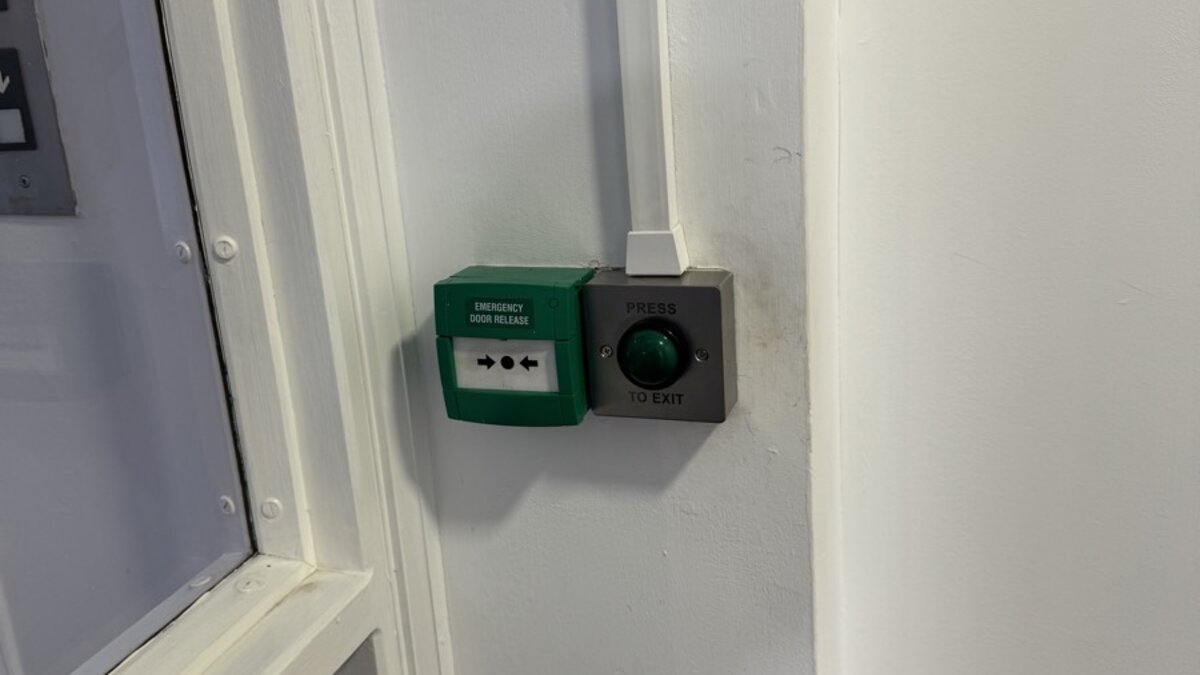
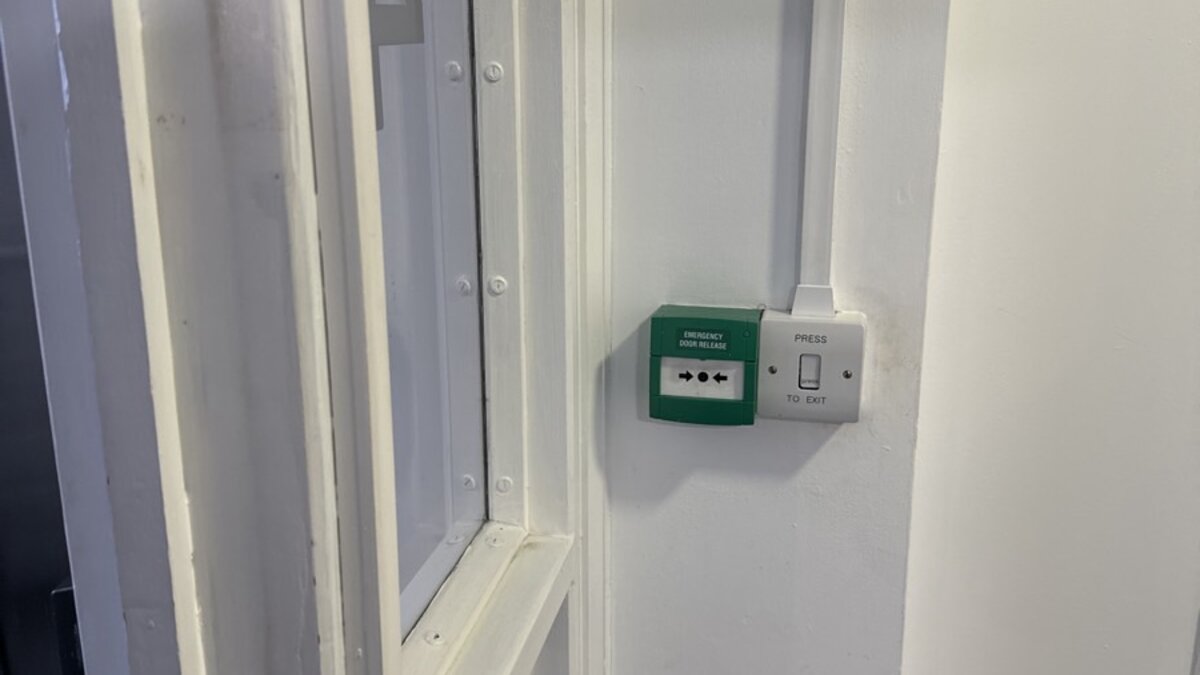
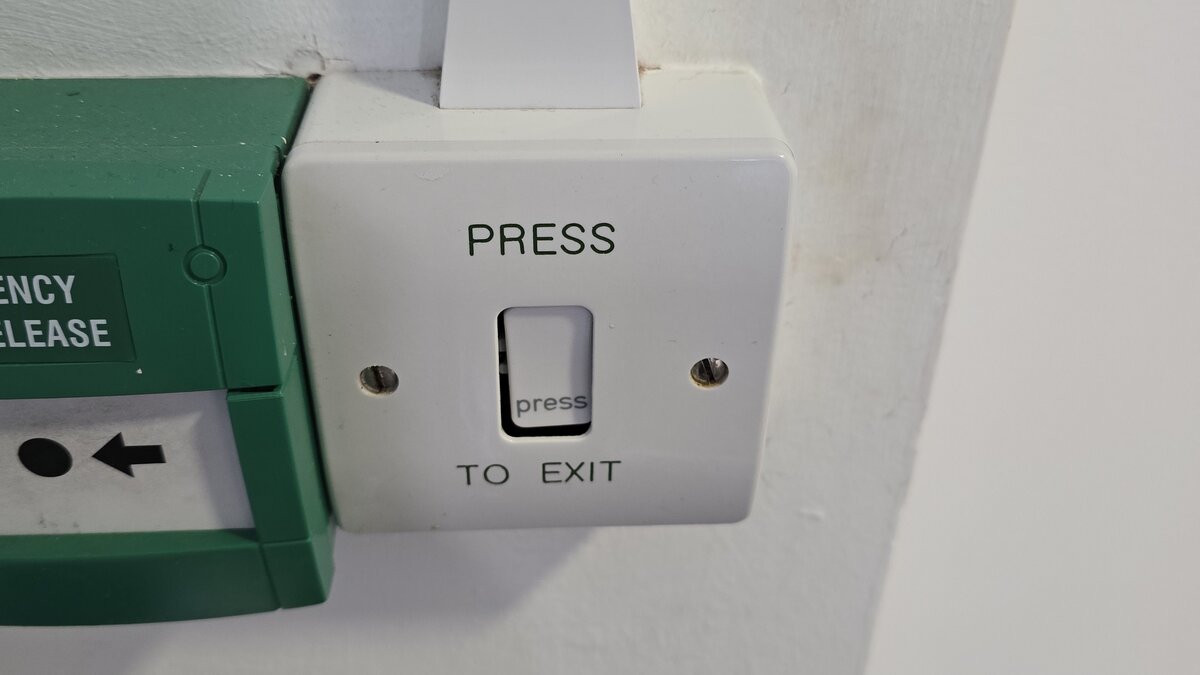
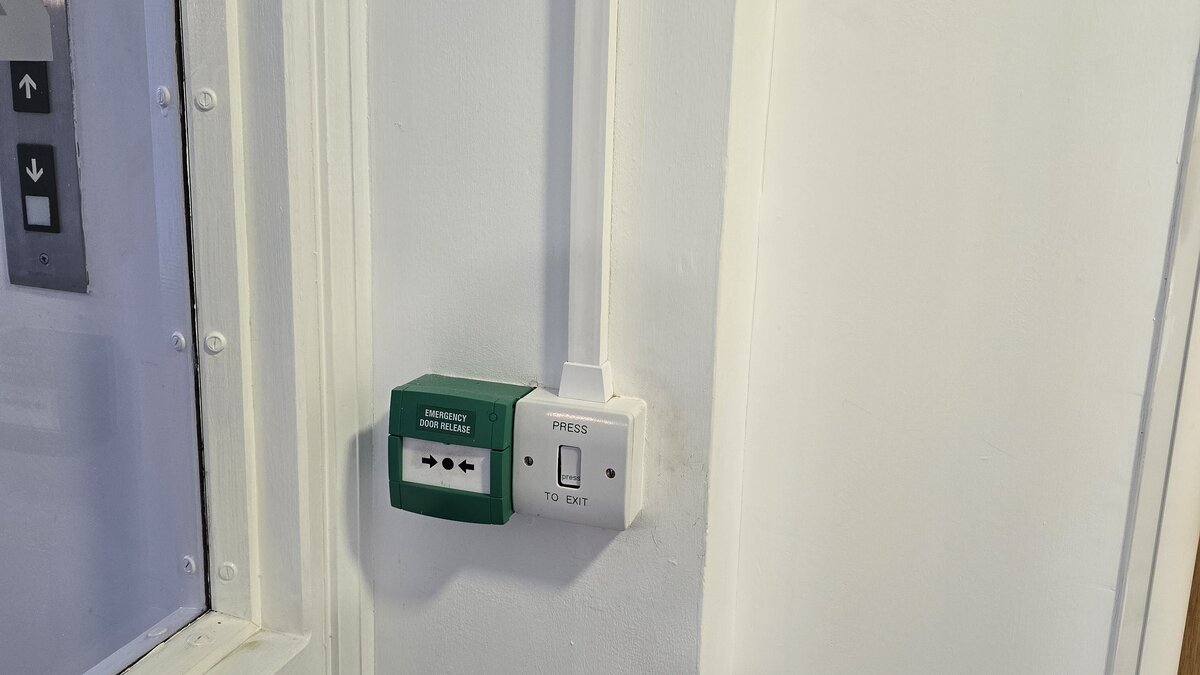
Electromagnetic locks (maglocks) use a powerful electromagnet mounted on the door frame and a steel armature plate on the door leaf. When energised, the magnet holds the door closed with a typical holding force of 300 to 600 kg — far beyond what any person could overcome by pushing or pulling. This is by design: the lock must resist forced entry. But the same characteristic that makes maglocks effective for security creates a critical dependency on the release mechanism. If the exit button fails, occupants are effectively trapped behind a door they cannot open.
The Regulatory Reform (Fire Safety) Order 2005 (RRO) makes the legal position unambiguous. Article 14 requires that routes to emergency exits, and the exits themselves, must be kept clear and available for use at all times when the premises are occupied. A magnetically locked door on an escape route must have a reliable manual release — typically an exit push button — that immediately cuts power to the magnet and allows the door to swing open. BS 7273-4 provides the code of practice for the operation of fire protection measures, including the actuation of release mechanisms for doors held by electromagnetic locks. It specifies that the release must be simple to operate, clearly identified, and positioned at an accessible height.
Building Regulations Approved Document Part B (Fire Safety) reinforces the requirement that all doors on escape routes must be openable in the direction of escape without the use of a key, and that magnetically locked doors must incorporate fail-safe release mechanisms. The term “fail-safe” is critical here — in the event of a power failure, the magnet de-energises and the door releases automatically. But a failed exit button is not a power failure; it is a component failure that leaves the magnet energised and the door locked. Until the button is replaced, the system is operating in a compromised state.
BS EN 50133 provides the broader standard for access control systems, including requirements for testing, maintenance, and component specification. The exit button is a safety-critical component within this standard, and its failure constitutes a defect that must be remediated promptly.
For commercial office buildings — particularly those housing multiple tenants or operating as serviced office spaces — a failed exit button may also trigger obligations under the Health and Safety at Work Act 1974, which requires employers to ensure, so far as is reasonably practicable, the safety of all persons on the premises.
The Requirement
The building management company — NewFlex Leases Limited, operating as Citibase — instructed replacement of the maglock exit push button at Audley House, 13 Palace Street, Victoria, London SW1E 5HX. The existing button had failed, and the occupants could not release the magnetically locked door from the inside using the normal exit procedure.
The Works — Step by Step
Our engineer attended on 15 January 2026 and completed the replacement, including testing, within a single visit.
Assessment of existing installation. The engineer inspected the failed exit button, the wiring connections, and the maglock circuit. The purpose of this initial assessment was twofold: to confirm that the button itself was the faulty component (rather than a wiring break, relay failure, or magnet fault), and to identify the specification of the existing button for like-for-like replacement.
Removal of faulty button. The failed exit push button was disconnected from the access control wiring and removed from the mounting position. The wiring was inspected for damage, corrosion, or loose connections that may have contributed to the failure or could affect the replacement unit.
Installation of new exit button. A new exit push button of matching specification was mounted in the same position, connected to the existing access control circuit wiring, and secured. The wiring connections were made with correctly rated terminals, ensuring reliable electrical contact.
Circuit testing. The complete maglock circuit was tested end to end. When the exit button was pressed, the power to the electromagnetic lock was interrupted, the magnet de-energised, and the door released. When the button was released and the door closed, the magnet re-energised and re-engaged the armature plate, locking the door.
Functional verification. The door was tested through multiple open-close cycles to confirm consistent, reliable operation. The release was immediate on button press, and re-engagement was positive on door close.
Common Maglock System Failure Modes
| Symptom | Likely Cause | Safety Implication |
|---|---|---|
| Button pressed, door does not release | Exit button failure; wiring break; relay fault | Occupants cannot exit — immediate fire safety concern |
| Door releases intermittently | Loose wiring connection at button or relay | Unreliable egress; may fail when most needed |
| Door does not lock after closing | Armature plate misaligned; magnet fault; power supply issue | Security compromised; door unsecured |
| Buzzing or heat from maglock | Magnet drawing excessive current; armature gap | Electrical fault; potential fire risk from overheating |
| Door releases on its own | Power supply fluctuation; access control panel fault | Security compromised; investigate power supply |
| Exit button physically damaged | Impact damage, vandalism, or wear | Replace immediately — safety-critical component |
| Fire alarm does not release maglock | Break glass or fire alarm interface not wired correctly | Critical life safety failure — immediate remediation |