UPVC doors rely on a multipoint locking mechanism housed within the door slab. Unlike traditional mortice locks that engage a single bolt, multipoint systems typically throw three or more locking points — hooks, bolts, or rollers — into corresponding keeps in the door frame when the handle is lifted and the key is turned. This distributed locking provides significantly better resistance to forced entry than a single-point lock.
The mechanism is, however, a precision component operating within a plastic frame that expands and contracts with temperature changes. Over time, the internal springs weaken, the gearbox wears, and the locking points cease to engage reliably. In Scotland, where temperature variation between seasons is considerable and coastal areas such as Dundee experience salt-laden air, the corrosion and wear process can be accelerated.
BS 3621:2007 (Thief resistant lock assembly — Key egress) is the standard most commonly referenced by insurers when specifying minimum lock requirements for external doors. While BS 3621 was originally written for traditional mortice locks, the principle it establishes — that a door lock must resist attack and operate reliably — applies equally to multipoint mechanisms. The more recent BS PAS 24:2022 (Enhanced security performance requirements for doorsets and windows) sets out the performance standard for the complete doorset assembly, including the locking mechanism, and is referenced in Building Regulations Approved Document Q (Security in dwellings).
For landlords and property managers, the Landlord and Tenant Act 1985, Section 11, imposes a statutory obligation to keep the structure and exterior of the dwelling in repair, which includes the front door and its locking mechanism. A property with a non-functional front door lock is a property in disrepair, with consequences for both tenant safety and landlord liability.
The Instruction
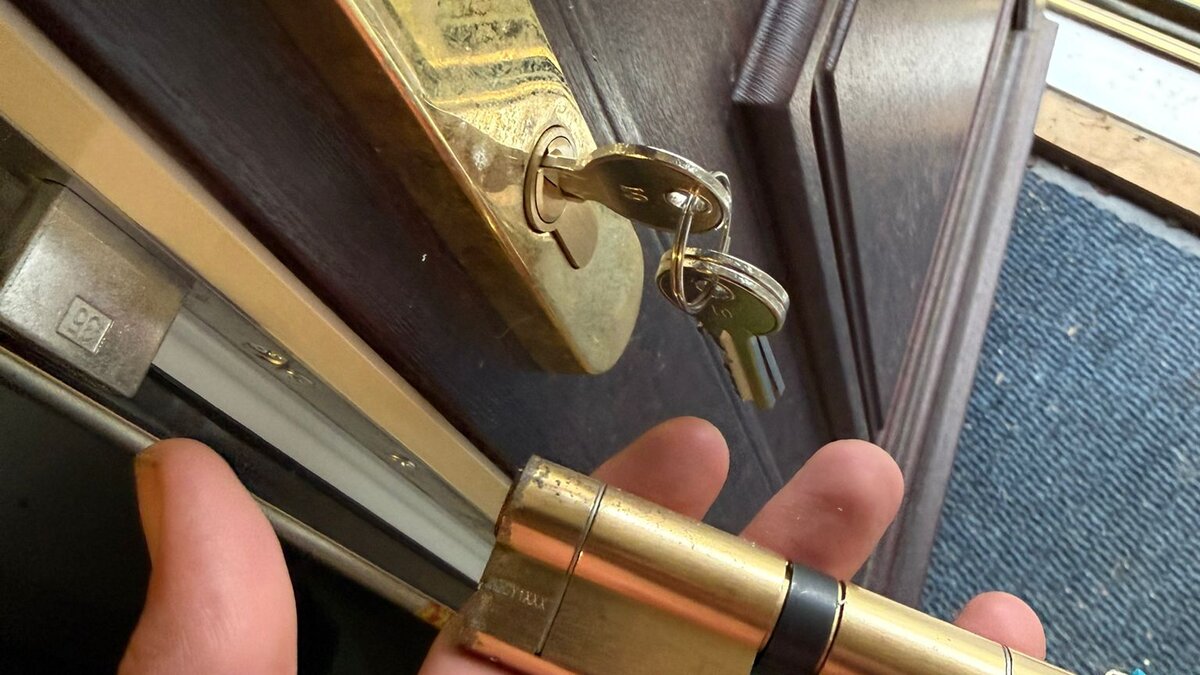
We’ve Got The Key Limited, a key management and property access company, instructed the supply and replacement of two UPVC front door locks at a residential property on Sandeman Street, Dundee. Both locks were specified as lift-handle-to-lock type configurations — the standard multipoint mechanism found on the majority of UPVC residential front doors.
The Works: Step-by-Step
Step 1 — Mechanism Identification: Our locksmith attended and examined both doors to identify the existing lock specifications. UPVC multipoint mechanisms vary by manufacturer, backset, centres (the distance between the cylinder and the handle spindle), and the type and number of locking points. Correct identification is essential — an incorrect replacement will not fit the door or engage with the existing keeps.
Step 2 — Removal of Old Mechanisms: The door handles and cylinder were removed to access the locking mechanism. The old multipoint strips were withdrawn from the door slab. The internal channel was inspected for debris or damage that might interfere with the new mechanism.
Step 3 — Supply and Fitting of New Locks: Two new multipoint locking mechanisms were supplied, matched to the existing door specifications. Each mechanism was inserted into the door slab, aligned with the locking point keeps in the frame, and secured.
Step 4 — Handle and Cylinder Refitting: Door handles and lock cylinders were refitted and adjusted. The handle operation was tested to confirm smooth lifting action that engages all locking points simultaneously.
Step 5 — Comprehensive Testing: Both locks were tested thoroughly: keys turning smoothly in both directions, handles lifting cleanly to throw the locking points, all bolts and hooks engaging fully into the frame keeps, and the door closing and latching without binding. The property was confirmed as fully secured.
Common UPVC Lock Failure Modes
Property managers and landlords should be alert to the following indicators of multipoint lock degradation.
| Failure Mode | Cause | Warning Signs |
|---|---|---|
| Gearbox failure | Internal mechanism wear, spring fatigue | Handle lifts but locking points do not engage |
| Misalignment | Door drop, frame movement, thermal expansion | Difficulty turning key, locking points catch on keeps |
| Cylinder snapping | Attack or fatigue in standard cylinders | Key turns but does not operate mechanism, visible damage |
| Locking point wear | Repeated use degrades hook or bolt profiles | Door locks but can be pushed open with force |
| Handle spindle failure | Spindle snaps or wears at square drive | Handle turns but does not operate mechanism |
| Keep misalignment | Frame settlement or hinge wear | Locking points do not enter keeps fully |