Fire Alarm Inspection Services UK – BS 5839 Annual System Tests
Facilities managers and Responsible Persons in UK non‑domestic buildings need BS 5839‑aligned annual fire alarm tests that genuinely prove systems still perform. A structured programme covers every device, panel, interface and record over the year, with checks tied to how the building is actually used, depending on constraints. By completion, you hold a clear report, prioritised defect list and evidence pack you can show to fire inspectors, insurers or lenders with confidence. Moving toward your next audit or renewal can then feel controlled rather than exposed.


Author
Izzy Schulman

BS 5839 Annual Fire Alarm Tests Explained for UK Sites
If you are the Responsible Person for a UK non‑domestic building, you need more than a quick walk‑round to claim your fire alarm is maintained. Annual tests under BS 5839‑1 exist to prove the system still matches the building and will perform when it is needed.

Enforcement officers, insurers and lenders usually start by asking for records, not assurances. A properly structured annual programme ties weekly tests and six‑monthly servicing into a coherent year, producing reports, device coverage evidence and defect tracking that stand up to scrutiny and reduce avoidable fire safety risk.
- Understand what a true BS 5839 annual test includes
- See how annual tests support your Fire Safety Order duties
- Know what to expect from a competent fire alarm provider
Need Help Fast?
Locked out, leak at home, or electrical issue? All Services 4 U provides 24/7 UK locksmith, plumbing, electrical.
Testimonial & Clients Who Trust Us
With 5 Star Google Reviews, Trusted Trader, Trust Pilot endorsements, and 25+ years of experience, we set industry standards for excellence. From Dominoes to Mears Group, our expertise is trusted by diverse sectors, earning us long-term partnerships and glowing testimonials.
Worcester Boilers

Glow Worm Boilers

Valliant Boilers

Baxi Boilers

Ideal Boilers

BS 5839 Annual Fire Alarm Tests that Prove Your System Still Performs
You want to know your fire alarm will actually do its job on the day and that your paperwork will stand up when somebody serious asks for it.
We carry out BS 5839‑1 annual inspection and testing across UK non‑domestic premises, confirming your system still matches the building, delivers the coverage you need, and operates as designed. You leave with findings you can work with, prioritised defects, and an evidence pack you can put in front of a fire inspector, insurer, lender or board.
If you have an audit, insurance renewal, refinance or fire risk assessment on the horizon, an annual test structured this way closes off a key area of risk.
If you already know your panel make, approximate device count and last service date, you can move straight to booking a consultation at the end of this page and lock your dates in.
What a BS 5839‑1 Annual Test Really Is
You do not want a contractor calling a quick visit an “annual test” when it clearly is not.
Under BS 5839‑1, the annual requirement is a defined set of checks completed over the year, not a token once‑a‑year walk‑round. That year’s work is usually delivered through one or more service visits. Across that 12‑month window, every required inspection and functional check must be done. The aim is to prove the system still meets the original design intent and still provides suitable fire detection and alarm cover for how the building is actually used now.
BS 5839‑1 is the accepted code of practice that shows what a “suitable system of maintenance” looks like for non‑domestic fire alarm systems. When your annual testing regime follows that pattern, you can point to it as objective evidence that you have taken reasonable steps.
How it fits with weekly and 6‑monthly checks
A simple way to think about the regime is:
- Weekly testing by your team shows the system can still raise an alarm and indicate correctly at the panel.
- Six‑monthly servicing by a competent organisation is planned maintenance that checks a proportion of devices, reviews the logbook, and manages faults and disablements.
- Annual completion is the point by which every device and relevant interface has been functionally checked at least once and the broader system performance has been reviewed.
You still need the weekly and 6‑monthly layers. The annual requirement sits on top of them and ties the year together into a programme you can show to an auditor as coherent, risk‑based maintenance rather than a string of ad‑hoc visits.
What Is Included in a BS 5839 Annual Inspection and Test
![[ALTTOKEN]](https://allservices4u.co.uk/app/uploads/2026/01/02-Fire-Alarm-Inspection-Services-UK-BS-5839-Annual-System-Tests.jpg)
You should never be left guessing what has actually been inspected, tested and verified during the year.
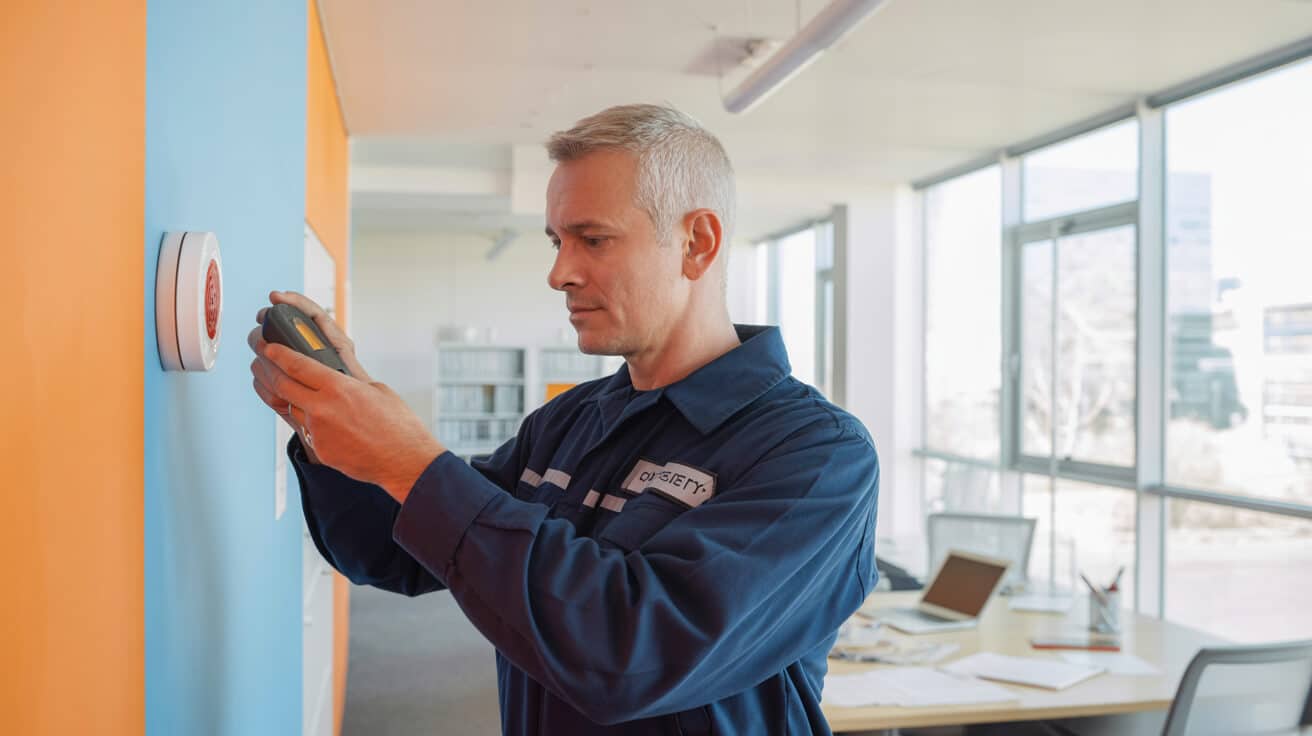
At annual level, the scope is wider than a quick “sounders on, reset, go” check. A competent engineer will review the condition and performance of the control and indicating equipment, standby power, detection and call points, sounders and visual alarms, interfaces (such as door releases, smoke control, plant shutdown or lift recall), and the way the system responds as a whole. The goal is to pick up obvious faults and slow performance drift that would otherwise stay hidden until you need the system.
Engineer checklist at a glance
A well‑structured annual programme typically includes:
- Device coverage: every detector, manual call point, sounder and interface functionally tested over the year, with results recorded against an identifiable list.
- Panel and indications: operation of all relevant controls, lamps, displays and fault monitoring, including correct zone indication and timing.
- Standby power: condition and capacity checks on batteries and power supply equipment, with defects or end‑of‑life findings clearly called out.
- Interfaces and cause and effect: witnessed operation of key inputs and outputs so you know that doors release, lifts behave correctly, smoke control runs, and plant responds as intended.
- False alarm and fault trend review: use of logbook entries and engineer observations to highlight recurring problems and propose realistic mitigations.
- “Change since last year” review: a sense‑check that layout changes, partitioning, new uses of space or noise levels have not undermined the original alarm strategy.
You should see these themes reflected in the service report rather than a single word such as “satisfactory”. That is how you avoid nasty surprises later.
How Annual Tests Support Your Fire Safety Order Duties
You are expected to prove you maintain fire protection, not just say that you do.
When enforcement officers, fire risk assessors, insurers or lenders look at your arrangements, they typically start by asking for your records. A BS 5839‑aligned annual test that is properly documented gives you a simple, defensible storey to tell.
The evidence pack a Responsible Person should keep
A practical evidence pack for fire alarms usually includes:
- System and site details: current panel information, zone plans, system category and any significant interfaces.
- Logbook records: routine tests, faults, disablements, alarm activations and actions taken, kept reasonably up to date.
- Service reports and certificates: clearly showing what was tested, the date, who attended, and whether the system was left in a satisfactory condition or with noted variations.
- Device lists and coverage statements: enough information to demonstrate that all points and interfaces have been covered across the year.
- Defect and remedial action register: a list that ties each defect to an owner, a target date and confirmation that it has been rectified or risk‑assessed.
- Key photo evidence where helpful: for example, panel “normal” condition at handover, labelling improvements, or corrected interface terminations.
When your annual test is set up to generate these items as standard, you reduce the stress of any inspection and make it easier to brief new stakeholders and contractors without losing continuity or control.
Accreditations & Certifications








Who Is Competent to Carry Out Your Annual Test
![[ALTTOKEN]](https://allservices4u.co.uk/app/uploads/2026/01/03-Fire-Alarm-Inspection-Services-UK-BS-5839-Annual-System-Tests.jpg)
You want to be sure the organisation you bring in can genuinely stand behind the work.
In UK practice, competence is normally demonstrated at company level through independent certification, and at individual level through training, experience and control of test equipment. You do not have to become a technical expert yourself, but you should be clear about the basics before you appoint or renew a provider.
Checks you can make before you instruct a provider
Pragmatic due‑diligence steps include:
- Check third‑party certification: look for appropriate schemes covering fire detection and alarm maintenance, and verify the scope and modules on the scheme owner’s register.
- Confirm relevant experience: ask which panel families and system types the engineers work on regularly, and whether they have recent experience of systems similar to yours.
- Ask about test equipment control: confirm that instruments used for measurements are identified, maintained and calibrated at sensible intervals, with records available if requested.
- Clarify reporting standards: request a sample (redacted) report showing how scope, findings, defects and recommendations are recorded.
- Understand configuration controls: for systems where programming changes may be required, confirm how changes are approved, documented and verified.
- Check basic governance hygiene: insurances, risk assessments, safe systems of work and, where appropriate, screening for staff who will attend sensitive sites.
When you can show that you appointed a competent provider on the basis of objective checks, you strengthen your own position as a Responsible Person or manager and remove one more line of attack in any investigation.
Costs and What Drives the Price of Annual Fire Alarm Testing
You see big swings in quotes because not every provider is pricing the same job.
Most providers base annual servicing fees on the time and planning required to complete the defined checks safely and thoroughly. That effort is heavily influenced by the size and complexity of your system and the environment in which it operates, not just by how many times someone walks through the door.
Key factors that change labour and fee levels
Common cost drivers include:
- Number and type of devices: more detectors, call points, sounders and interfaces mean more time on site, especially where access is difficult.
- System configuration: addressable networks, multiple panels, graphical interfaces and complex cause‑and‑effect arrangements take longer to verify than small stand‑alone panels.
- Interfaces and dependencies: lifts, door releases, smoke control, plant shutdown and monitoring links all add setup, witnessing and coordination time.
- Access and permits: work at height, secure areas, lone‑working restrictions, permit‑to‑work processes and escort needs all reduce productivity and must be planned.
- Out‑of‑hours and disruption controls: where tests must happen outside normal hours or in tightly controlled windows, mobilisation and attendance costs can increase.
- Reporting depth and follow‑up support: a simple job sheet costs less to produce than a detailed, audit‑ready report with action plans and management summaries.
A transparent quote will usually explain how these factors have been allowed for, so you can compare offers on more than headline price and choose the level of assurance you want.
How All Services 4U Delivers Annual BS 5839 Tests
You want annual testing that actually de‑risks your position, not another checkbox exercise.
All Services 4U structures BS 5839‑1 annual testing as a planned programme rather than a one‑off event. The focus is on practical risk reduction, clear evidence for your files, and a delivery model that respects how your site operates, so you are not stuck firefighting disruption while you try to prove compliance.
Step‑by‑step: how your annual test runs with us
A typical engagement follows this pattern:
- Scoping and information‑gathering: you share key facts such as panel make and model, approximate device count, known interfaces, previous reports and any particular concerns.
- Access and interface planning: we agree how to reach high‑level devices, risers and secure areas, and how to handle interfaces such as lifts, doors and plant shutdown with the relevant stakeholders present.
- On‑site testing and inspection: our engineers work through the agreed plan, covering devices, panel functions, standby power, interfaces and “change since last year” checks, while updating the logbook as they go.
- Reinstatement and handover: before leaving, we ensure the system is returned to normal condition, confirm any temporary measures in place, and walk through key findings with your nominated contact.
- Reporting and actions: you receive a structured report, defect and recommendation list, and an updated picture of system condition and compliance position.
- Follow‑up support: where remedial works are needed, we help you prioritise and programme them, so actions do not sit unresolved between annual cycles.
The emphasis is on giving you the practical information you need, not just closing a job number and moving on.
Reliable Property Maintenance You Can Trust
From routine upkeep to urgent repairs, our certified team delivers dependable property maintenance services 24/7 across the UK. Fast response, skilled professionals, and fully insured support to keep your property running smoothly.

Book Your Free Consultation With All Services 4U Today
You can take the uncertainty out of your next annual test in a single focused conversation.
During a free consultation, you outline your premises, your current testing pattern and any upcoming audit, insurance or refinance pressures. We then map those against BS 5839‑1 expectations and your legal duties, and suggest a proportionate annual testing and evidence plan for your sites.
If you decide to proceed, the next step is straightforward. You confirm panel details, an approximate device count, known interfaces, access constraints and preferred working windows, and we turn that into a written testing proposal and delivery plan you can circulate internally.
Choose a consultation slot that fits your diary, bring your latest fire risk assessment and any recent service reports, and use the session to de‑risk your next annual test and lock in the records you need for inspectors, insurers, lenders and your board.
Frequently Asked Questions
Explore our FAQs to find answers to planned preventative maintenance questions you may have.
How is a BS 5839‑1 annual fire alarm test different from weekly and six‑monthly checks?
A BS 5839‑1 annual test proves the whole fire alarm strategy still works as a system, while weekly and six‑monthly checks only prove slices of it.
How do the weekly, six‑monthly and annual layers line up in plain English?
For you as RTM director, BSM or Head of Compliance, it helps to see the three layers side‑by‑side:
| Check type | Owned by | What it actually proves this week/year |
|---|---|---|
| Weekly user test | Your on‑site team | The system is live, audible/visible and staff are alert. |
| Six‑monthly service | Competent maintenance contractor | Key components are healthy and faults are under control. |
| Annual completion | Competent maintainer + Responsible Person sign‑off | The system still meets BS 5839‑1 and your fire strategy. |
Weekly tests are deliberately simple: operate a different manual call point, confirm sounders and beacons operate, check the panel responds and resets, and record it in the logbook. You’re proving “this system is awake and staff know it exists”, not doing formal maintenance.
Six‑monthly visits are where a competent firm applies BS 5839‑1 Section 6 in practice: sampling detectors and call points, testing a proportion of sounders and interfaces, checking panel indications, reviewing disablements and logbook entries, and clearing down faults. That regime keeps the system healthy enough that the annual review won’t ambush you.
Across the full 12‑month period, BS 5839‑1 expects every detector, call point, sounder, beacon and interface to be function‑tested at least once, standby supplies to be proven, and cause‑and‑effect (doors, smoke control, lifts, plant shutdown) to be witnessed end‑to‑end. The annual sign‑off is effectively you, as Responsible Person, saying under the Fire Safety Order that the system remains suitable and is being maintained.
If you can explain that three‑layer pattern in one slide and back it with clean evidence, you look like the person who runs BS 5839‑1 as a management system, not a box‑tick.
What should sit with your internal team versus your maintenance company?
Internally, your team should own the touch‑points that live closest to day‑to‑day risk:
- Weekly tests and clear logbook entries.
- Obvious housekeeping: access to call points, damage, local audibility.
- Prompt escalation of faults, repeated false alarms and any routine disablements.
Your BS 5839‑1 maintenance contractor should own the technical and compliance backbone:
- Six‑monthly and annual maintenance to BS 5839‑1 Section 6 and Clause 45.
- Fault diagnosis, configuration changes and backups, with change records.
- The annual completion statement and detailed report that can stand in front of a fire authority officer, Building Safety Regulator, insurer or lender.
Write that split into your fire safety policy, contracts and scopes. The day an enforcing officer asks “Who is responsible for ensuring BS 5839‑1 maintenance is actually being delivered here?”, you want to answer in one sentence and then quietly slide the evidence pack across the table.
What should actually be included in a BS 5839‑1 annual fire alarm inspection and test?
A credible BS 5839‑1 annual inspection shows that every significant device and interface has been function‑tested over 12 months and that the system still matches how the building is used today.
What does full device and interface coverage really mean?
Clause 45 of BS 5839‑1 expects that, within each 12‑month period, every point and every important interface is exercised at least once. In practical terms that means:
- All detectors: – point, beam, aspirating – tested with appropriate stimulus, not just by hitting “test” on the panel.
- All manual call points: – each operated at least annually, with covers and break‑glass elements checked.
- All sounders and beacons: – every device verified in situ so you’re not relying on a sample that hides dead spots.
- All interfaces and I/O modules: – doors, dampers, smoke control, lifts, plant shutdown, door holders, security tie‑ins.
- Control and indicating equipment: – indications, controls, event log, fault monitoring and any printer or repeater.
- Power supplies and standby batteries: – condition checked and capacity proven so a mains failure doesn’t leave you silent long before the design duration.
You should be able to put a coverage report or device export next to your drawings or asset register and see that nothing has quietly fallen out of scope.
A serious annual also steps back and asks whether the design assumptions still match the building. If uses have changed, partitions have moved, noise levels have gone up or layouts have been reconfigured, the engineer should flag that as “design drift” for you and your fire risk assessor to consider. In more complex buildings, that question links directly to your fire strategy under BS 9999 and, for HRBs, your Safety Case.
How can you quickly test whether an annual scope is robust before you sign?
As a BSM, Asset Manager or Finance Director, you don’t have time to read every line of BS 5839‑1, but you can ask three simple questions:
- Coverage: “Show me how full device and interface coverage will be achieved over the year and reported back at point level.”
- Interfaces: “Explain how you will test each interface end‑to‑end – doors actually releasing, smoke control actually running, lifts responding – not just a light on the panel.”
- Reporting: “What will I see in the annual report – device counts, locations, interface results and variations, or just ‘system satisfactory’?”
If a contractor can’t map their proposal to Clause 45 in clear language, you are not buying an annual regime; you are buying a day of labour with a BS 5839‑1 logo on the header.
The higher the risk of the building, the more that detail matters. When you can drop a device coverage report, an interface test summary and a clear annual certificate into a Board paper or Safety Case, you stop hoping and start proving that the BS 5839‑1 duty has been discharged.
What records and evidence should a Responsible Person keep after the annual BS 5839‑1 test?
You want a fire alarm evidence pack you can pull in two minutes that tells a complete, defensible storey from requirement to close‑out for each building.
What does a simple, defensible fire alarm evidence pack look like?
Aim to standardise a structure that works for a fire authority officer, Building Safety Regulator, insurer, lender and your own Board:
- System overview: panel make/model, coverage category, detection zones, high‑level cause‑and‑effect, and any smoke control or lift integration.
- Logbook: weekly user tests, faults, false alarms, disablements, investigations and outcomes, signed and dated.
- Service and test reports: six‑monthly and annual BS 5839‑1 reports, with device counts, interfaces tested, variations and limitations clearly described.
- Device and interface coverage: an export or schedule showing which points and interfaces were tested in the period.
- Defect and remedial register: graded by impact and urgency, with owners, target dates and closure evidence.
- Photos: panel status at handover in “normal” condition, key interfaces, and any significant upgrade or remedial works.
When the paperwork is tidy and boring, the conversation with the regulator usually is too.
If you are also managing BS 7671 electrical safety, gas safety or water hygiene duties, keep those certificates and logs adjacent so you can show how your fire alarm regime joins up with the wider life‑safety picture.
How do you keep records live so audits stop feeling like interrogations?
Treat fire alarm records as a live binder, not a dumping ground:
- Index everything by site → system → year, with consistent names so anyone in your team can find items quickly.
- Start each contractor visit by reviewing the existing evidence pack together; make “what did we learn since last year?” a standing agenda item.
- Drive your defect log like a workstream across compliance, operations and finance – it should feed your fire risk assessment, Safety Case, PPM changes and capital bids.
When a regulator, insurer or valuer walks in, the power move is to say “Give me two minutes”, come back with a clear pack and calmly walk them through how your weekly checks, six‑monthly visits and annual completion tie together. That’s the quiet competence All Services 4U is trying to make your default setting, not a lucky year.
How do you know if a fire alarm maintenance company is genuinely competent for BS 5839‑1 annual testing?
You should be able to defend your chosen maintenance provider in front of an enforcing officer, insurer or coroner without hiding behind “they seemed fine” or “procurement picked them”.
What hard indicators of competence can you point to?
Start with independent, third‑party certification that explicitly covers fire detection and alarm maintenance, not just installation or general electrical work. Check the scheme’s public register and scope, not just logos in an email footer.
Then drop to the people and method:
- Engineer competence: recent experience with your panel type and network, comfortable with complex interfaces such as smoke control, door release and lift control.
- Method aligned to BS 5839‑1 Section 6 and Clause 45: staged testing, clear plan for annual coverage, proper interface testing and standby supply checks.
- Measured values where needed: sound pressure and battery tests carried out with calibrated instruments, not guesswork. When those tests sit alongside your BS 7671 electrical safety regime, you want the numbers to stand up.
- Configuration control: backups taken, cause‑and‑effect changes recorded, access to password‑protected settings controlled and signed off.
Ask for a redacted sample report for a building similar to yours. You’re looking for evidence that they understood the fire strategy, interfaces and building use – not just that they pressed a few call points and printed “left working”.
Wrap that with sensible governance: insurance aligned to your risk, RAMS that make sense in your environments, and appropriate vetting where residents or vulnerable users are present. A competent company will be ready to hand that over before you ask.
What quick red flags tell you to step back?
You don’t need to be a fire engineer to spot trouble:
- Proposals that say “all to BS 5839‑1” with no breakdown of device numbers, interfaces or reporting detail.
- Reports that never touch cause‑and‑effect, interfaces, standby supplies or design drift; everything is just “tested and left working”.
- No traceable third‑party certification for maintenance; only generic trade badges.
- No mention of calibrated instruments where BS 5839‑1 expects measured values.
- No curiosity about your fire risk assessment, HRB status, Building Safety Act duties, insurance conditions or wider life‑safety picture.
A Head of Compliance, Building Safety Manager or Asset Manager needs to be able to say “Here is why we trusted this firm and here is the proof of how they maintain the system.” All Services 4U assumes that justification will be tested one day, so we design it in up front: clear scopes, traceable competence and reports you can drop straight into a Safety Case or Board pack without rewriting.
What outcomes should you expect from annual tests, and how do you turn remedials into a controlled pipeline?
The useful outcome of an annual BS 5839‑1 programme is not a “satisfactory” stamp; it is a clear, prioritised list of what must change in your system and supporting evidence you can actually act on.
What patterns do strong annuals usually surface?
Across mixed‑use, higher‑risk and higher‑rise buildings, the same categories keep appearing:
- Technical drift: contaminated or poorly located detectors, devices bypassed during old projects, interfaces that no longer match drawings or cause‑and‑effect documents.
- Power weaknesses: batteries and power supplies degraded so that a mains failure would end protection far earlier than intended.
- Record drift: logbooks with gaps, out‑of‑date zone plans, undocumented panel changes made during previous call‑outs.
- Human workarounds: zones permanently disabled, call points taped over in “problem” locations, staff silencing instead of investigating.
In the current regulatory climate, not knowing these patterns is more dangerous than having them. Fire risk assessments, Safety Cases and insurer surveys expect you to understand where the system is drifting and to be able to show what you are doing about it.
How do you turn remedials into a transparent workstream instead of a rolling crisis?
As a Head of Compliance or Asset Manager, your challenge is rarely lack of information; it’s lack of structure. Ask your provider to grade each defect on two simple axes: life‑safety impact and time sensitivity. For example:
| Grade | Typical issues | Expected response |
|---|---|---|
| A | No detection in escape route, dead sounder circuit, critical interface failure | Immediate action, interim measures, rapid permanent fix |
| B | Degraded coverage, labels missing, ageing batteries, outdated zone plans | Planned works within an agreed programme window |
| C | Housekeeping, documentation tidy‑up, non‑urgent optimisations | Fold into minor works and improvement projects |
Use that grading to:
- Decide what must be fixed immediately, and what becomes part of a small‑projects or capital programme.
- Drive updates to your fire risk assessment or Safety Case where the risk profile changes.
- Highlight the issues that should be visible to your Board or Building Safety Committee.
When your remedials live on a single register with clear owners, budgets and dates, your annual BS 5839‑1 reports become year‑on‑year improvement reviews, not the same issues resurfacing in a different font. That’s the point where you stop apologising for old reports and start showing trend lines.
All Services 4U designs annual testing and remedials to feed that pipeline: issues graded in language your compliance, finance and operations teams can work with, so you can walk into a meeting with a storey about progress, not just a stack of PDFs.
How can All Services 4U make BS 5839‑1 annual testing easier to defend and easier to live with?
All Services 4U treats BS 5839‑1 maintenance as a joint performance review on your system and your paperwork, so you can prove control in front of any audience without turning fire alarms into a second job.
How does the service run before, during and after each annual cycle?
Before we put an engineer on site, we work with you – RTM director, managing agent, BSM, Head of Compliance, Asset Manager or Finance lead – to map the essentials:
- Panel type, loops, networks and any integration with smoke control, lifts or security.
- Approximate device and interface counts so we can plan coverage properly.
- HRB status and any Building Safety Act or Safety Case commitments.
- Upcoming fire authority audits, insurer surveys, lender valuations or Board milestones.
From that, we build a BS 5839‑1 maintenance programme rather than scattering diary appointments. You see in writing how full coverage will be achieved, how interfaces will be tested, and what you can expect in the reports.
On site, our engineers work to an agreed method aligned to BS 5839‑1 Section 6 and Clause 45. They test the devices and interfaces we’ve scoped, manage disablements transparently, keep you briefed on emerging issues and make sure the system is either fully reinstated or left with clear interim measures and notes where it cannot be.
Afterwards, you receive more than a generic “satisfactory” line. You get:
- Device and interface coverage reports: that reconcile with your drawings or asset register.
- Defect grading: with sensible interim controls and target dates, ready to drop into your remedial pipeline.
- Narrative you can reuse: in a fire risk assessment review, Safety Case narrative, Board paper, insurer submission or valuation pack.
- For HRBs, evidence that supports your Safety Case, not material that fights it.
We can then help you align remedials with service‑charge planning or capital budgets, so the next annual confirms improvements instead of replaying avoidable history.
What is the lowest‑friction way to move this off your desk while staying firmly in control?
Block out an hour and pull together four things for one conversation:
- Your latest fire risk assessment or Safety Case summary.
- Basic panel and site details – make, model, number of loops, HRB status.
- A rough device and interface count – detectors, call points, sounders, key interfaces.
- Your most recent service report and logbook snapshot.
Using just that, you can sit down with All Services 4U and decide, as the person carrying the duty, whether you want us to:
- Take on the full BS 5839‑1 maintenance and evidence model as your ongoing partner, or
- Start with a focused health check of your current contractor, scopes and records, so you have a clear, independent view before you change anything.
Either route, the goal is simple: you become the person who can show, not just say, that your fire alarm system is designed, maintained and recorded to a standard you’d be comfortable explaining to a regulator, an insurer or your own Board on the hardest day of the year.
- BS 5839 Annual Fire Alarm Tests Explained for UK Sites
- BS 5839 Annual Fire Alarm Tests that Prove Your System Still Performs
- What a BS 5839‑1 Annual Test Really Is
- What Is Included in a BS 5839 Annual Inspection and Test
- How Annual Tests Support Your Fire Safety Order Duties
- Who Is Competent to Carry Out Your Annual Test
- Costs and What Drives the Price of Annual Fire Alarm Testing
- How All Services 4U Delivers Annual BS 5839 Tests
- Book Your Free Consultation With All Services 4U Today
- Frequently Asked Questions
- Related PPM Services
Case Studies


Related Articles

Your Guide To Identifying And Treating Minor Mould Outbreaks
Why Planned Preventative Maintenance (Ppm) Saves Money And Ensures Compliance