Tenant Safety & Compliance PPM Services for Landlords – CO Alarms, Smoke Alarms & Safety Certificates
Landlords and property managers who manage multiple rented homes need a safer, clearer way to keep smoke alarms, CO alarms and safety certificates under control. A planned preventive maintenance service brings checks, remedials, scheduling and evidence into one managed workflow, depending on constraints. By the end, your portfolio has defined visit dates, documented findings, completed follow-up actions and a record trail that stands up to scrutiny. It’s often worth starting with a focused compliance review to see where your current process can be tightened.


Author
Izzy Schulman

Managing smoke alarms, CO alarms and safety records across a growing rental portfolio is difficult when dates, faults and documents are scattered. Landlords carry clear legal duties, and missing a check or losing evidence can leave tenants at risk and files harder to defend.

A structured planned preventive maintenance approach brings alarms, certificates, inspections and remedial work into one organised system. All Services 4U coordinates schedules, visit outcomes and follow-up actions so you can see what is due, what has been done and where gaps remain, without relying on memory or last-minute bookings.
- Keep alarm checks and key safety dates on schedule
- Build clearer evidence of what was tested and fixed
- Reduce last-minute compliance rush across your rented portfolio</p>
Need Help Fast?
Locked out, leak at home, or electrical issue? All Services 4 U provides 24/7 UK locksmith, plumbing, electrical.
Testimonial & Clients Who Trust Us
With 5 Star Google Reviews, Trusted Trader, Trust Pilot endorsements, and 25+ years of experience, we set industry standards for excellence. From Dominoes to Mears Group, our expertise is trusted by diverse sectors, earning us long-term partnerships and glowing testimonials.
Worcester Boilers

Glow Worm Boilers

Valliant Boilers

Baxi Boilers

Ideal Boilers

Stay compliant, protect tenants and keep every safety date under control
A planned compliance routine gives you a safer, clearer way to manage smoke alarms, carbon monoxide alarms, certificates, checks and follow-up work across each property, instead of relying on memory, late booking or scattered paperwork. At All Services 4U, we bring those duties into one practical workflow, so you have a clear route from move-in checks to ongoing scheduling, remedials and evidence across your property.
You need the right equipment in the right place, the right checks at the right time, and a record trail that shows what was tested, found and done next.
If you want fewer missed dates and cleaner records, start with a compliance review that shows what is due, what is missing and what needs attention first.
What landlords in England must provide for smoke alarms and CO alarms
England rules are clear on what must be installed, but day-to-day control still depends on how you manage the property.
A lot of confusion starts because many landlords know alarms matter, but not where the legal line sits. In England, the duty is not just to have alarms somewhere in the property. It is tied to installation, tenancy start and fault response.
What must be installed
You need at least one smoke alarm on every storey used as living accommodation.
You also need a carbon monoxide alarm in any room used wholly or partly as living accommodation where there is a fixed combustion appliance. In England, that excludes gas cookers, but you still need to review the room layout, appliance type and occupancy properly.
What must be checked at the start of a tenancy
You must make sure the required alarms are in working order at the start of a new tenancy.
That day-one check matters because legal duty, tenant safety and record keeping meet there. If a tenancy begins without a working alarm setup, you start from a weaker position than you need to.
Where portfolios often go wrong
The mistake is treating England guidance as if it applies the same way across the whole UK.
If you manage homes in Scotland, Wales or Northern Ireland, alarm standards and supporting duties can differ. One England checklist should not be copied across every address without reviewing the local framework.
What counts as a certificate, and what still needs recording
Smoke and CO alarms are safety duties in England, but they are not a stand-alone annual certificate regime like gas safety.
Some providers talk about alarm certificates as if every alarm visit creates a statutory document equivalent to a CP12. That blurs a distinction you need to understand before you compare services.
Formal certificates and reports
A Gas Safety Record, often called a CP12, is a formal annual gas document where gas appliances, fittings or flues are provided by the landlord.
An Electrical Installation Condition Report is a formal electrical report with inspection findings and, where relevant, follow-up actions. An EPC is also commonly managed alongside these documents as part of the wider letting and compliance process.
Alarm checks are evidence duties
Smoke and carbon monoxide alarms in England still need proof, even though the law does not create a separate annual statutory alarm certificate.
In practice, that means keeping reliable records of what was installed, what was tested at the start of the tenancy, what faults were reported, what was repaired or replaced, and when the next review point falls. An invoice on its own is rarely enough if it does not show the outcome.
Why wording matters
The wrong label creates the wrong expectation.
If your team or your tenants think an alarm certificate exists when what you actually hold is a contractor note, test record or replacement log, the file becomes harder to defend later. Clear wording protects you because it ties the evidence to the real duty.
Which checks expire, and when they should be planned
Some safety dates are fixed by law, while others need active review points built into your maintenance calendar.
The easiest way to lose control is to treat every safety item the same. Gas, electrics and alarms do not all run on one identical cycle, and a good PPM plan separates formal expiry dates from practical review points.
The dates that usually drive the schedule
Gas safety is the clearest annual trigger where gas is present, and electrical inspection is the main longer-cycle trigger in England.
Current England guidance for private rented homes generally points to gas checks every 12 months and electrical inspection and testing at least every five years, or sooner if the report requires it. Alarm duties work differently: the core legal trigger is installation plus a working check at the start of a tenancy, with repair or replacement if faults are found.
This table shows how landlords usually plan the core items.
| Item | Typical planning point in England | Evidence you should keep |
|---|---|---|
| Gas Safety Record | Every 12 months where gas is present | Current record and issue history |
| EICR | At least every five years or sooner if required | Current report and remedial close-out |
| Smoke alarms | Install, test at tenancy start, review on faults and lifecycle | Test record, replacements, fault history |
| CO alarms | Install where required, test at tenancy start, review on faults and lifecycle | Test record, replacements, fault history |
| EPC and related property records | Track against letting and portfolio management needs | Current document and renewal date |
The dates people miss
Formal expiry is only half the problem.
You also need lead time for booking, tenant access, no-access cases, remedials and document issue. A certificate that expires in 30 days can become a problem sooner if nobody has secured the visit window or checked whether earlier actions remain open.
The review points beyond expiry
Alarms need review events even where there is no annual statutory alarm certificate.
That includes tenancy changes, void works, refurbishments, appliance changes, end-of-life dates, low-battery reports, damp ingress, physical damage and resident concerns. If you only think about alarms when a tenant complains, you are already running a reactive model.
What a tenant safety and compliance PPM service includes
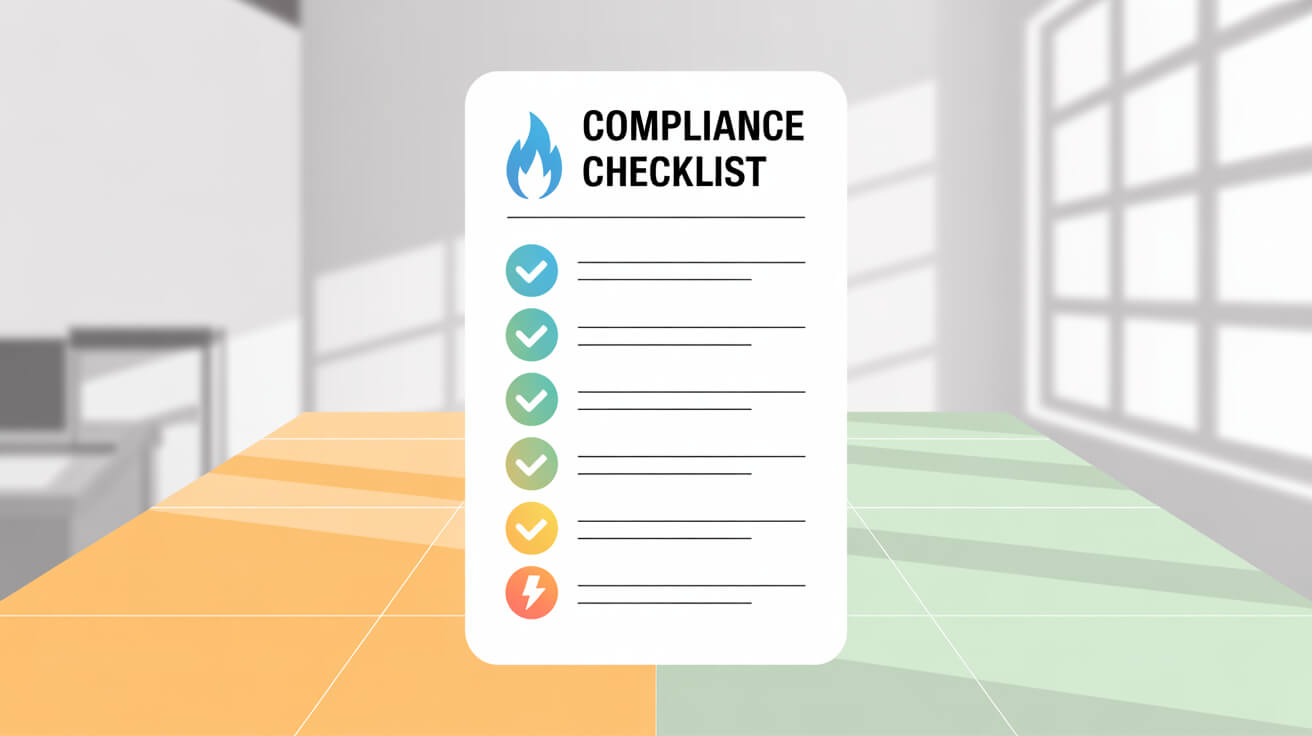
A proper service covers scheduling, checks, records, remedials and control points, not just isolated visits.
This is where buyers usually compare a managed programme with a cheaper one-off contractor booking. The difference is not just price. It is whether the work leaves you with a closed loop or another loose end.
What gets managed
A good compliance PPM service usually brings these moving parts together:
- reminder-led scheduling across each property
- access coordination with tenants or site contacts
- alarm inspection, testing and replacement tracking
- certificate booking, issue and storage
- remedial logging and close-out monitoring
- evidence packs for later review
That combination matters because missed duties usually happen in the handoff between those steps, not in the test itself.
What alarm servicing should cover
A useful alarm visit does more than press a button.
For smoke alarms, servicing usually includes a visual condition check, a basic siting review, functional testing and a check for obvious damage, contamination or tampering. For carbon monoxide alarms, the visit should also consider alarm type, power source, location, visible condition and end-of-life status where identifiable.
What you should leave with
You should leave with more than a contractor memory and a vague note.
You need a dated record of attendance, the location and status of the device, what was tested, what was found, whether the unit remains serviceable, and what action is required next. Where formal certificates or reports apply, they should sit inside the same managed workflow rather than being chased separately.
If you want one route from alarm checks to certificates and evidence, that is where a managed service starts saving you time.
How the process works from pre-let to occupied tenancy

The safest workflow starts before keys are handed over and keeps running after the tenancy begins.
A lot of landlord stress comes from treating compliance as something that starts on move-in day. In reality, your strongest control point is the period just before occupation, because that is when you can close gaps without disrupting a resident.
Before move-in
You review what is already in date, what is required for the specific home, and what evidence must be issued or retained.
That usually means checking gas status where relevant, confirming the electrical position, reviewing smoke and CO alarm coverage, and making sure known defects or expired units are not being carried into the new tenancy.
At move-in
You confirm the required alarms are present and working on the day the tenancy starts.
That moment matters because it is the clearest line in the process. If an alarm fails that day, the issue is live immediately. If the check is completed and recorded properly, you start the tenancy from a much stronger compliance position.
During the tenancy
You do not stop managing the file once the keys are handed over.
You keep the next gas or electrical date visible, log alarm faults, track replacement points, store evidence in a consistent format and move remedials through to completion. If access problems or resident reports create delay, those actions should still leave a visible trail rather than disappearing into email chains.
At All Services 4U, we structure that flow so your property file stays usable, not just populated.
Accreditations & Certifications








Why managed PPM is safer than ad hoc bookings and fragmented contractors

You reduce risk when one controlled system links the check, the evidence and the follow-up action.
Ad hoc booking can work for a while, especially on a very small portfolio, but it usually breaks under pressure. The issue is not that one-off contractors cannot do good work. It is that you still carry the burden of stitching every step together afterwards.
Less deadline risk
A managed programme keeps the real deadline visible before it becomes urgent.
That matters most with annual gas dates, five-year electrical cycles, tenancy-start alarm checks and any shorter reinspection periods sitting inside current reports. You are not left discovering the risk when a tenant is due to move in or when a document has already lapsed.
Clearer accountability
One workflow makes it easier to see who owns the next action.
If a device needs replacing, a certificate needs issuing, access failed, or a report triggered remedials, the job should not disappear between separate suppliers. Clear accountability is often the difference between a compliant file and an exposed one.
Better evidence when challenged
Records matter most when someone asks difficult questions.
That could be a tenant, a managing agent, a local authority, an insurer, a lender or your own board. If your file shows what was due, what was done, what failed, what was fixed and what remains open, you are in a much stronger position than if the answer depends on verbal recall.
If you are tired of compliance living in spreadsheets, inboxes and contractor promises, this is the point to move to a planned model.
Reliable Property Maintenance You Can Trust
From routine upkeep to urgent repairs, our certified team delivers dependable property maintenance services 24/7 across the UK. Fast response, skilled professionals, and fully insured support to keep your property running smoothly.

Book Your Free Consultation With All Services 4U Today
You get more value from the first conversation when your current position is visible from the start.
Bring your latest gas record, electrical report, alarm inventory if you have one, any known install or replacement dates, open faults and any tenancy starts coming up soon. We will review what is legally required, what is best practice, what is already covered and where the real gaps sit.
That gives you a clearer basis for action. You can see whether you need a simple tidy-up, a recurring compliance schedule, targeted remedials, or a more structured portfolio workflow.
If you manage several homes, we can help you prioritise the addresses nearest a deadline, the records that are incomplete and the issues most likely to create avoidable risk. If you manage one or two properties, we can still turn a scattered set of reminders into a cleaner, easier plan.
Book your free consultation with All Services 4U today.
Frequently Asked Questions
What should you do when a tenant reports a faulty alarm between scheduled property maintenance visits?
You should treat a faulty alarm report as an immediate safety task that needs fast attendance and a clean record trail.
A planned property maintenance programme gives you order. A live fault report shows whether your team actually has control.
When a tenant reports a chirping, disconnected or damaged alarm, the risk changes straight away. A chirp may mean low battery, contamination, sensor failure or end-of-life warning. A disconnected unit is more serious because the protection you think is in place may not be functioning at all.
That moves the issue out of routine scheduling and into active risk management. In practice, you need the report logged the same day, the alarm type identified, access arranged, the unit inspected, and the result recorded in a way that links the complaint to the attendance and the action taken.
A safety device only counts when your records show it was working when it mattered.
Why does a minor alarm fault become a bigger compliance problem so quickly?
Because the danger is rarely the noise itself. The danger is the gap between the report and your response.
Shelter’s landlord guidance makes the wider point clearly: where a safety measure is not working, a landlord cannot rely on the idea that it will sort itself out. The expectation is response, not delay.
If your file shows that a tenant reported a fault on Monday and nobody attended for two weeks, that delay becomes part of the risk picture. If the file shows the report, attendance, replacement and follow-up in one sequence, you can show that the issue was controlled.
That matters to landlords, managing agents and housing teams because fault handling often sits outside tidy annual certificates. A gas record may still be current. An electrical report may still be in date. Yet the alarm fault raised last Tuesday can still leave you exposed if it was never closed properly.
What should your fault log capture first?
The strongest fault logs are simple and complete. They should show:
- report date and time
- property address and room
- alarm type
- stated fault
- attendance date and engineer
- finding on inspection
- action taken
- next review or replacement date
That looks basic because it should be. Most audit failures do not come from missing technical detail. They come from information being split across email chains, contractor texts and separate job notes.
Which response steps make the record defensible later?
A defensible response usually follows one chain from start to finish. This table shows the difference between a weak record and a usable one.
| Stage | Weak record | Strong record |
|---|---|---|
| Report | “Tenant called” | Time, location, alarm type, stated issue |
| Attendance | “Engineer attended” | Attendance time, device checked, findings logged |
| Outcome | “Resolved” | Replaced, reset, retained or escalated with reason |
| Forward control | No next step | New review date and asset update recorded |
That joined-up chain is what matters when a resident complains, a client asks what happened, or a board member wants proof that the team did more than simply visit.
A low-cost provider can attend and still leave your team carrying the risk if they do not connect the report, the site action and the updated record. In property maintenance, the weak point is often not the visit. It is the handoff afterwards.
If your alarm faults still travel through inboxes and memory rather than one clear workflow, the process is already costing you time. All Services 4U helps landlords and managing agents turn alarm faults into tracked, closed, review-ready actions, so your team is not rebuilding the story later under pressure.
Which records should you reset before a property is re-let after a void period?
You should reset every record that proves the property was checked, made safe and handed over in a controlled condition.
A void period looks like breathing space. In reality, it is where weak compliance habits get exposed.
The property is empty, trades are moving through, deadlines are tight and everyone wants the next tenancy to start quickly. That is exactly when checks drift, replacement dates get missed and handover files end up thinner than anyone expected. Good property maintenance during a void is not about doing more paperwork. It is about making sure the right safety and condition records are reset before the keys go out.
GOV.UK guidance on landlord safety responsibilities supports the practical principle here: compliance matters at the point the tenancy begins, not only at some earlier stage when someone last looked at the property.
Why do void periods reveal process weaknesses so fast?
Because access is no longer the excuse.
If a home is empty and your team still cannot confirm alarm status, electrical position, gas safety where relevant, or which defects were closed before occupation, the issue is not tenant availability. The issue is process control.
Voids often pull teams into a rush pattern. Cleaning gets booked. Decoration gets signed off. Minor repairs happen. But the evidence trail stays fragmented. One contractor updates a folder. Another sends a PDF. Someone else confirms a check by email. Then move-in day arrives and nobody can show a single, clean handover picture.
That is where void management stops being an admin exercise and becomes a risk issue.
What should sit together in a move-in file?
Your move-in file should show the condition before occupation, the checks completed, the defects closed and what falls due next.
| Record | What it proves | Best point to update |
|---|---|---|
| Gas safety record | Gas compliance where gas is present | Before occupation |
| Electrical report and remedials | Installation status and closed actions | During void works |
| Alarm test confirmation | Required alarms worked at handover | Day of key release |
| Defect close-out log | Issues were fixed, not only noted | Before sign-off |
| Asset update | Replacements and installs are now current | Immediately after change |
This is where a sharper table helps. Each line should answer a different question, not repeat the same one in different wording.
What usually gets missed when re-let pressure builds?
The common misses are rarely dramatic. They are usually the small gaps that later create bigger questions.
Older alarms with no clear install date. Minor electrical remedials left open after the main report. Damp indicators noted but not tracked through to reinspection. Replacement units fitted but never added to the asset list. Handover checks done on site but not filed where anyone can retrieve them.
Those misses matter because a resident concern on day three quickly becomes a file test. Can you show the property was ready on day zero?
Empty homes do not remove risk. They remove excuses.
For property owners and managing agents, a controlled void process means fewer move-in surprises and fewer apologetic updates after occupation. For compliance leads, it means cleaner records. For lenders or valuers, it shows the property is run with discipline rather than assumption.
A strong void workflow also protects speed. You can turn a property around quickly without losing control if your route is fixed: alarm check, gas record, electrical review, remedial closure, asset update, next-due scheduling.
If your void handover still depends on separate folders, contractor notes and memory, it is worth tightening the process before the next tenancy starts. All Services 4U helps turn void periods into a proper compliance reset, so re-letting feels controlled rather than rushed.
How should you compare property maintenance providers without being trapped by a low quote?
You should compare providers by their follow-through, evidence quality and exception handling, not by the first attendance price.
A cheap quote can look efficient because it reduces the visible service to a visit, a certificate or a simple test. That often feels commercial. It rarely feels commercial once something goes wrong.
The real cost usually appears later, when access fails, a fault stays open, a replacement is not recorded, or no one can tell your team what is due next. At that point, the savings on the first line item are gone, and your staff are carrying the admin burden anyway.
The National Residential Landlords Association consistently frames safety duties as ongoing management responsibilities. That is the right lens for provider comparison. You are not only buying a certificate. You are buying the system around the certificate.
Why is a certificate-only offer often a false economy?
Because a certificate is one point in time, while compliance risk lives in everything that happens before and after it.
A provider can issue a document and still leave you with unanswered questions. What happens if the tenant is not home? What happens if the alarm fails the next week? Who chases remedials? Who updates the next-due cycle? Where does the evidence sit when a client or insurer asks for it?
Those are not edge cases. They are normal operating conditions.
That is why the stronger comparison is not “who can attend cheapest?” It is “who leaves your team with the fewest uncontrolled loose ends?”
Which comparison questions reveal weak providers fastest?
Ask questions that expose the service model, not just the visit rate.
- What exactly is included in the visit?
- What evidence is issued after attendance?
- How are failed checks escalated?
- Who owns remedials through to closure?
- How are no-access appointments handled?
- How are next-due dates updated?
- Can one reporting view cover multiple compliance areas?
Those questions matter because they reveal whether you are buying support or buying new admin for your own staff.
What warning signs should you look for before appointing anyone?
The most common failure pattern is predictable.
The first visit happens. The document arrives. An unresolved issue sits between the contractor, the inbox and the calendar. Nobody clearly owns the next step. Then a resident asks for proof, a board asks for status, an insurer asks what precautions were in place, or a lender checks the file and the whole arrangement suddenly looks thin.
A stronger provider should be able to explain their process in plain terms. They should show what gets logged, how exceptions are handled, where the evidence is stored and how your team sees drift early rather than late.
For managing agents, that means less chasing and more client confidence. For compliance teams, it means stronger portfolio reporting. For landlords with mixed stock, it means a more consistent standard across properties. For finance stakeholders, it means easier forecasting and cleaner remedial planning.
If you are comparing one-off contractors against a managed property maintenance route, this is where the decision becomes clearer. All Services 4U helps you compare delivery models on what actually matters: control, evidence, speed of follow-through and how well the process holds up once real-life exceptions start landing.
Where does the audit trail usually break, even when the work itself has been done?
It usually breaks between attendance, remedial follow-through and proper filing.
Most audit failures do not start with total inaction. They start with partial action that was never joined up properly.
Someone attends site. A report is issued. A fault is identified. A replacement happens. But the chronology never gets stitched together well enough to prove what happened from start to finish. When scrutiny arrives, intent does not matter much. The record does.
The Housing Ombudsman’s case learning repeatedly shows the same practical pattern: disputes get harder to defend when the landlord or managing agent cannot show a clean chain of events. In property maintenance, disconnected records are almost as damaging as missing ones.
Which weak links cause the most trouble?
The weak links are usually ordinary, not dramatic.
- no-access logs
- remedial completion notes
- replacement dates for alarms
- next-due updates
- linked tenant fault reports
- version control on superseded records
Each one seems small on its own. Together, they make the property history look uncertain.
This is why a folder full of documents can still fail under pressure. Volume is not continuity.
What should a usable audit trail show from start to finish?
A usable audit trail should let someone follow one clear sequence without reconstruction.
| Stage | What should be visible | Why it matters |
|---|---|---|
| Due | Planned task or legal trigger | Shows the duty existed |
| Booked | Appointment or instruction | Shows action started |
| Attended | Site visit evidence | Shows the visit happened |
| Found | Defect, test result or observation | Shows what was known |
| Done next | Repair, replacement or escalation | Shows control after discovery |
| Due next | Revised future date | Shows the cycle continues |
That structure matters because it turns a pile of separate documents into one readable chain.
Why do good teams still lose this chain?
Usually because the systems around the job are weaker than the job itself.
Photos stay on phones. Certificates arrive after the work order was marked complete. Contractors keep their own notes. Spreadsheet calendars are never updated when a reactive event changes the cycle. Emails hold key approvals that never make it into the main record.
That is where a lot of teams get frustrated. They did the work. They just cannot prove it quickly enough.
For boards and freeholder representatives, the benefit of a joined-up audit trail is simple: more confidence. For managing agents, it means cleaner client reporting. For legal or tribunal contexts, it means stronger chronology. For residents, it often means faster answers instead of repeated explanations.
If your record still depends on somebody remembering to move information from one place to another, the chain is weaker than it looks. All Services 4U helps landlords, agents and compliance teams connect visits, faults, remedials and future due dates into one usable property maintenance record, so the answer is already there when the question lands.
Why does manufacturer end-of-life guidance matter when an alarm still seems to work?
It matters because a unit can still sound during a test and still be too old to trust.
This is where many portfolios carry hidden risk.
A lot of teams still judge alarms by visible failure. If the button works and the sounder goes off, the assumption is that the unit is fine. That is not a reliable standard. Smoke and carbon monoxide alarms are timed safety devices. Their sensing elements have finite service lives, and those service lives vary by model and manufacturer.
Kidde and other major manufacturers make that point clearly in their product guidance: replacement should follow the stated service-life limits for the specific unit. In practice, age tracking is part of safety control, not an optional admin task.
Why is “it passed the button test” not enough?
Because a test button does not prove full sensing reliability.
It confirms a limited function at that moment. It does not confirm that the sensing element remains within the period where the manufacturer says it should be depended on. That is a much more useful standard for landlords, agents and compliance teams.
Once a device moves beyond its expected service life, the issue is not only battery condition. It is whether you can reasonably rely on the alarm at all. That is why install dates, replacement dates and end-of-life indicators matter so much in a property maintenance system.
What should your replacement logic include?
A sensible lifecycle approach should include:
- installation or replacement date
- make and model reference
- manufacturer service-life rule
- visible end-of-life indicator checks
- immediate asset update after replacement
That gives your team a better basis for future decisions. It also makes handovers, audits and insurer questions easier to answer because you are managing alarms as assets, not as background fittings.
Where does the hidden exposure usually sit?
It often sits in mixed-age stock where earlier replacements were reactive rather than planned.
That creates the dangerous illusion of compliance. The property may look tidy on paper. The alarm may still produce a sound. But the underlying reliability may already be outside what the manufacturer intended.
The quietest risk is often the device nobody thought to question.
That is the real belief shift. The risky alarm is not always the one that is visibly broken. It is often the one that has quietly aged out while everyone assumed it was still acceptable.
For landlords, that means unknowns spreading across stock over time. For managing agents, it means handover surprises. For compliance leads, it means weaker lifecycle control. For lenders and insurers, it raises questions about how seriously the wider asset base is being managed.
A focused review of alarm age profile usually surfaces problems quickly, especially where historic records are patchy. If you cannot say with confidence which units are still within service life and which are drifting beyond it, All Services 4U can help you separate dependable assets from silent exposure before that gap becomes a much bigger issue.
Who needs to see your safety records, and what should they be able to understand immediately?
Your records should let residents, boards, insurers and lenders see current risk, closed actions and what happens next.
A strong safety file is not only for formal audits or incidents. It is for everyday pressure.
A resident may ask whether checks were carried out before move-in. A landlord PPM client may ask whether control is being maintained. An insurer may ask what reasonable precautions were in place. A lender or valuer may want to see whether risk is visible and managed. A board may want a clear picture of overdue actions and recurring faults.
The record set has to work for all of them. That means it has to be readable, not simply complete.
UK Finance guidance points to the broader principle lenders care about: evidence quality and visible risk control. The same logic applies more widely. If your records are technically present but hard to interpret, they are weaker than they look.
Who reads the same file in different ways?
Different audiences ask different questions, even when they are looking at the same property.
| Audience | What they want to know | What should be easy to find |
|---|---|---|
| Resident or occupier | Was the home checked and made safe? | Handover and closure records |
| Landlord or managing agent | Is control being maintained? | Compliance calendar and action log |
| Insurer or broker | Were reasonable precautions in place? | Condition-precedent proof and incident trail |
| Lender or valuer | Is risk visible and current? | Core record currency and asset status |
| Board or compliance lead | Where are the open issues? | KPI view, ageing actions, recurring faults |
This is why the file should not read like a storage cupboard. It should read like a controlled operating record.
Why does readability matter as much as completeness?
Because hidden evidence is only slightly better than missing evidence.
A technically complete folder still fails if your team has to reconstruct the position from email chains, separate spreadsheets and contractor folders every time somebody asks a fair question. Under pressure, that delay looks like uncertainty.
Your team should be able to answer a short list of basic questions quickly:
- Was the property checked before occupation?
- Are the core records current?
- Were reported faults followed through?
- Are alarms still within service life?
- What actions are still open?
- What falls due next?
If those answers take more than a few minutes to assemble, the system is already creating cost.
What does a review-ready record set look like in practice?
A review-ready file groups documents by property, separates current and superseded records, and links inspections, faults, remedials and next-due actions clearly enough that someone new to the file can understand it fast.
That helps everyone for different reasons. Owners and landlords running landlord PPM avoid panic when questions come in. Managing agents protect client trust. Compliance teams spend less time chasing and reconciling. Finance and governance stakeholders make decisions with clearer sight of the actual position. Residents gain more confidence that reported issues are truly closed.
A lot of teams only feel the weakness of record disorder when renewal, refinance, complaint escalation or board scrutiny arrives. By then, the scramble has already started.
If your records are present but still hard to use, they are costing you more than they save. All Services 4U helps turn scattered certificates, close-out notes and due-date trackers into one review-ready property maintenance picture, so when someone asks the question, your answer is already organised.
- Stay compliant, protect tenants and keep every safety date under control
- What landlords in England must provide for smoke alarms and CO alarms
- What counts as a certificate, and what still needs recording
- Which checks expire, and when they should be planned
- What a tenant safety and compliance PPM service includes
- How the process works from pre-let to occupied tenancy
- Why managed PPM is safer than ad hoc bookings and fragmented contractors
- Book Your Free Consultation With All Services 4U Today
- Frequently Asked Questions
- Related PPM Services
Case Studies


Related Articles

Your Guide To Identifying And Treating Minor Mould Outbreaks

Why Planned Preventative Maintenance (Ppm) Saves Money And Ensures Compliance