Fire Alarm Testing PPM Services UK – BS 5839 Weekly & Annual
Facilities, estates and compliance leads in the UK can keep fire alarm systems aligned with BS 5839 from weekly tests through to annual servicing. A structured PPM regime combines routine user checks, 6‑monthly engineer visits and clear documentation, adjusted by risk assessment where applicable. You end up with a single, workable schedule, defined roles, competent support and evidence that stands up to audits and enforcement. It’s a straightforward way to stay in control of your Responsible Person duties.



Author
Izzy Schulman

Structuring BS 5839 fire alarm testing into a clear regime
If you are responsible for a non‑domestic or communal building, you must be confident your fire alarm will operate and that your records will withstand scrutiny. BS 5839 sets expectations for testing and servicing, but turning that into a workable routine is not always simple.

Without a clear PPM regime, weekly tests get missed, servicing drifts and you struggle to show that faults are controlled. By defining tasks, frequencies, roles and documentation in line with BS 5839, you gain a practical schedule that staff can follow and evidence that supports your legal position.
- Turn BS 5839 guidance into a one‑page, usable schedule
- Clarify who tests, who records and who approves work
- Build an audit‑ready trail of tests, faults and remedials
Need Help Fast?
Locked out, leak at home, or electrical issue? All Services 4 U provides 24/7 UK locksmith, plumbing, electrical.
Testimonial & Clients Who Trust Us
With 5 Star Google Reviews, Trusted Trader, Trust Pilot endorsements, and 25+ years of experience, we set industry standards for excellence. From Dominoes to Mears Group, our expertise is trusted by diverse sectors, earning us long-term partnerships and glowing testimonials.
Worcester Boilers

Glow Worm Boilers

Valliant Boilers

Baxi Boilers

Ideal Boilers

Keep your fire alarm compliant and evidenced, from weekly tests to annual servicing
You need to know your fire alarm will work and that your paperwork will stand up to scrutiny.
We help you turn BS 5839’s recommendations into a simple, repeatable testing and maintenance regime that fits how your building runs day to day.
For most non‑domestic and communal systems, that means a weekly user test, planned engineer servicing at least every six months, and a clear trail of defects and remedials. You need to show that checks are being done properly, faults are controlled, and your records tell a coherent storey.
All Services 4U provides BS 5839‑aligned PPM programmes for single sites and portfolios, combining weekly test support, 6‑monthly and annual servicing, and audit‑ready documentation. You keep control of your legal duties as Responsible Person; we give you the structure, competent resource and evidence to show you are meeting them.
Ask us to review your schedule and highlight where it is strong, thin or exposed.
What compliant fire alarm PPM actually means – and who owns which tasks
A compliant PPM regime is a defined set of tasks, frequencies and records, not just a vague contract line about maintenance.
You reduce risk when every activity is clearly described, assigned to a role, and backed by evidence you can retrieve quickly.
Scope of a BS 5839‑aligned PPM regime
You typically combine three building blocks:
- Routine user attention: – weekly tests and basic visual checks.
- Periodic inspection and servicing: – engineer visits to inspect, test and adjust the system.
- Repairs and improvements: – closing out defects, replacing end‑of‑life parts, and implementing agreed upgrades.
You decide which of these you keep in‑house and which you outsource; the Responsible Person remains accountable either way.
Roles and responsibilities
In practice you will have:
- A Responsible Person or senior dutyholder who answers for compliance.
- One or more nominated staff (caretaker, facilities team, concierge, duty manager) who carry out weekly tests and keep the logbook up to date.
- A competent fire alarm service provider who undertakes inspection, servicing and technical fault‑finding.
A good PPM arrangement makes it obvious who tests, who records, who decides on isolations, who authorises spend, and who confirms the system is back to normal after any work.
BS 5839 testing frequencies – weekly to annual, in one clear schedule
![[ALTTOKEN]](https://allservices4u.co.uk/app/uploads/2026/01/02-Fire-Alarm-Testing-PPM-Services-UK-BS-5839-Weekly-Annual.jpg)
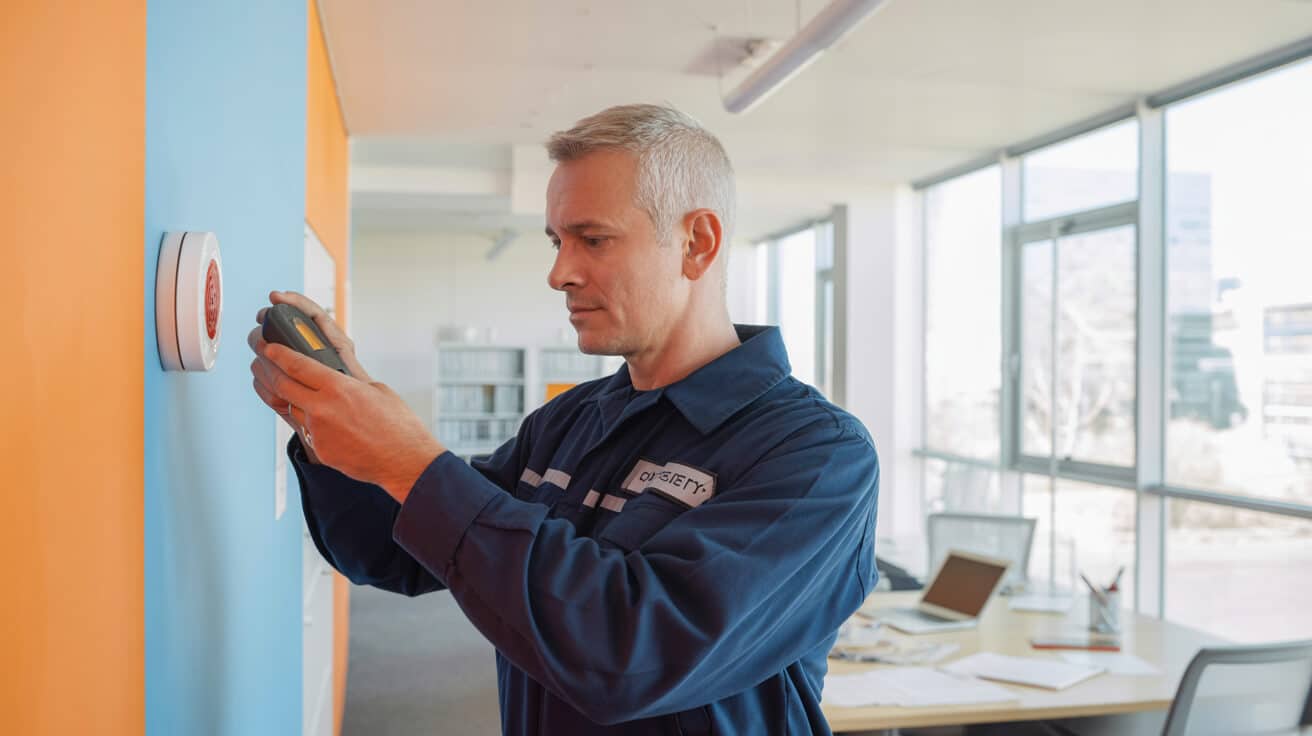
BS 5839 sets out recommended inspection and test intervals; your fire risk assessment then confirms what is appropriate for each building.
You gain control when that guidance is turned into a one‑page schedule that staff can follow without needing to open the standard.
Weekly user attention
Weekly attention usually means:
- Operating at least one manual call point.
- Checking the control panel shows the correct zone or address.
- Confirming the alarm sounds where expected.
- Resetting the system and checking that it returns to normal.
- Recording the result in the logbook, including any faults and actions.
Different call points are selected each week so that all points are tested over a reasonable period and you can show coverage over time, not just the point near reception.
Periodic engineer servicing
For most systems, competent engineer servicing is carried out at least every six months. Over the course of a year, all relevant devices and functions should be tested:
- Manual call points and detectors sampled so that 100% are tested within a defined cycle.
- Power supplies, batteries and fault monitoring verified.
- Ancillary functions and interfaces (for example door releases, smoke control, plant shutdown) checked as appropriate.
Higher‑risk or harsh environments may justify more frequent visits; your servicing plan should make that explicit so you can justify your regime.
Weekly user testing done properly – SOP, rotation and logs
A weekly test should be simple enough that any trained shift lead can carry it out consistently.
You avoid drift when the method, rotation and logging are standardised instead of reinvented on every shift.
Simple weekly test method
A practical SOP looks like this:
- Inform anyone who needs to know (reception, security, monitoring centre if applicable) that you are about to test.
- Operate the chosen manual call point with the appropriate test key or device.
- Confirm that the alarm sounds and the panel shows the correct zone or address.
- Silence and reset according to the panel instructions.
- Confirm the panel returns to normal and any monitoring connection shows the system restored.
This does not replace engineer servicing; it simply demonstrates that the system can raise and indicate an alarm and that staff know how to handle it.
Designing a rotation plan
You keep coverage honest by mapping all call points and assigning them to a rotation:
- Group points by stair, core, floor or zone.
- Test a different point each week at a consistent day and time.
- Include less convenient locations in the sequence, not just the call point by reception.
- Keep a simple list or matrix so you can see which locations have been tested recently.
What a good logbook entry looks like
An entry that will satisfy an auditor records:
- Date and time of the test.
- Identity and location of the device used.
- Result (pass/fail) and any unusual behaviour observed.
- Faults found, including panel messages.
- Immediate actions taken and the name of the person who will follow up.
If a weekly test is missed, you log the reason, any interim measures, and how you will bring the schedule back on track.
Accreditations & Certifications








Engineer servicing – what a competent 6‑monthly / annual visit should deliver
![[ALTTOKEN]](https://allservices4u.co.uk/app/uploads/2026/01/03-Fire-Alarm-Testing-PPM-Services-UK-BS-5839-Weekly-Annual.jpg)
Periodic servicing is where the system is examined in depth by someone with appropriate training and experience.
You gain assurance when you know what a proper visit should include and what documentation you will receive every time.
Core checks and sampling
At each servicing visit, you should expect:
- Visual inspection of the control panel, power supplies and a sample of devices.
- Functional testing of a proportion of manual call points and detectors, using appropriate test tools.
- Verification that sounders, visual alarms and any controls respond as designed.
- Review of logbook entries, faults and false alarm history since the last visit.
The servicing plan should explain how device sampling is arranged so that all devices are tested over a defined cycle, not just the easy ones.
Interfaces and cause‑and‑effect
Modern systems often control or signal to other equipment, such as:
- Door hold‑open devices and access control.
- Smoke control or ventilation.
- Lifts and plant shutdown.
- Remote monitoring centres.
You should agree which interfaces are within scope and how end‑to‑end operation will be verified. That usually means planning joint tests with other contractors where necessary and recording the results clearly.
Outputs you should receive
After each visit, you should receive:
- A service report describing what was inspected and tested.
- A list of defects, categorised by urgency or impact.
- Recommendations for any improvements or upgrades.
- A clear statement of system status and any remaining impairments.
Those documents should be easy to file alongside your logbook and fire risk assessment so that anyone reviewing them can see what has been done, what remains open and how it links back to risks.
If you want to benchmark your current reports against this standard, ask for a BS 5839 servicing review and we can walk through a recent visit with you.
Matching PPM to your system type, building risk and mixed‑use realities
Different systems and building types do not all justify the same regime.
You reduce wasted effort and residual risk when your plan reflects category, environment and occupation instead of copying a generic template.
System categories and standards
You should know, or confirm, whether your system is:
- A life‑safety category (for example L1–L5 under BS 5839‑1).
- A property‑protection category (for example P1 or P2).
- A communal system serving stairs, lobbies and plant rooms in a residential block.
- A domestic alarm arrangement in dwellings, which may fall under BS 5839‑6 instead.
That context guides how critical the system is to escape, how often it should be checked, and which parts of the building strategy depend on it.
Access and occupation
Real buildings introduce constraints:
- Restricted rooms and risers.
- Commercial tenants with limited access windows.
- Areas that can only be tested out of hours.
- Vulnerable residents or service users.
Your PPM plan should include an access strategy, including permits, keyholding, escorts and agreed quiet times, so tests and servicing can be completed reliably instead of being repeatedly deferred.
Residential blocks and mixed‑use challenges
In residential and mixed‑use schemes you often have:
- Common‑parts systems serving stairs and corridors.
- Separate systems or detectors in dwellings.
- Commercial units with their own arrangements.
You still need clarity on where BS 5839‑1 stops and BS 5839‑6 or other arrangements begin, who is responsible for each, and how cause‑and‑effect is managed where systems interact.
Audit‑ready evidence and unwanted fire signal control
Once your regime is running, the next test is whether you can prove it and whether it is reducing disruption rather than adding to it.
You put yourself in a strong position when evidence is organised and false alarms are treated as a controllable issue, not background noise.
Building your evidence pack
You should be able to assemble, quickly:
- Logbooks showing weekly tests, faults and actions.
- Service reports for each scheduled visit.
- A live defects register with status and closure evidence.
- Records of any impairments, including dates, reasons and measures taken.
If you look after a portfolio of blocks, you might standardise this into the same pack for every building and a simple dashboard view.
Managing faults and impairments
When a fault or impairment occurs, you benefit from a simple playbook:
- Who assesses the issue and within what response time.
- How risk is controlled while a part of the system is unavailable.
- Who authorises and records any isolation.
- How and when the system is restored to full operation.
Those steps should all leave a trace in your records, not just in email chains or verbal updates.
Reducing false alarms
Unwanted fire signals waste time, erode confidence and can attract attention from fire and rescue services or insurers. You can reduce them without compromising safety by:
- Analysing trends and locations instead of treating each event as isolated.
- Addressing underlying causes, such as unsuitable detector types or environmental conditions.
- Agreeing clear rules on investigation before system reset.
All Services 4U can review your history and servicing reports with you to help you build a practical reduction plan that sits alongside your PPM schedule and shows that you are tackling false alarms deliberately.
Reliable Property Maintenance You Can Trust
From routine upkeep to urgent repairs, our certified team delivers dependable property maintenance services 24/7 across the UK. Fast response, skilled professionals, and fully insured support to keep your property running smoothly.

Book your free BS 5839 fire alarm PPM consultation with All Services 4U
You may already have a contractor and a logbook, but still feel exposed when you are asked to show that the system is being tested and maintained properly.
You can use a short, focused conversation to turn that uncertainty into a clear, defendable plan.
In a free consultation, you share the essentials: building type, system category and age, approximate device counts and zones, current testing pattern, monitoring arrangements, access constraints and any known issues such as repeat false alarms or gaps flagged in your fire risk assessment. We then map BS 5839’s recommendations to your situation and outline a pragmatic schedule covering weekly user tests, engineer servicing and evidence.
We can either support your in‑house team with training and templates, or provide a full PPM service with weekly test support, 6‑monthly and annual visits, and structured reporting and dashboards.
You can then agree a BS 5839‑aligned fire alarm PPM plan that you can explain, operate and evidence with confidence. Book your consultation today and put that plan on firm ground before the next auditor, insurer or board pack asks for it.
Frequently Asked Questions
Explore our FAQs to find answers to planned preventative maintenance questions you may have.
How often should you test and service a BS 5839 fire alarm, and who does what?
A BS 5839‑1 fire alarm system needs a weekly user test and regular maintenance by a competent service provider. In UK practice, that means the Responsible Person under the Fire Safety Order 2005 keeps the Weekly & Annual routine and record‑keeping under control, while a third‑party‑certified contractor owns the 6‑monthly and annual BS 5839‑1 fire alarm maintenance, fault‑finding and formal reporting. Weekly testing is short and predictable: you operate one manual call point on a rotation plan, check the panel shows the right zone or address, confirm sounders in the right areas, reset the system and write a proper entry in the logbook. Over the year, your BS 5839 fire alarm maintenance contract then plans coverage of all relevant devices and functions so nothing is silently left out.
If you want to be seen as a competent Responsible Person rather than someone hoping the panel stays quiet, your team handles the simple weekly checks and escalation, and a provider like All Services 4U owns the deeper BS 5839‑1 competence, servicing and evidence.
How should you split responsibilities for BS 5839‑1 fire alarm maintenance?
A clean responsibility split keeps audits calm and stops blame‑shifting when something goes wrong.
- You / your site team: – weekly BS 5839 weekly fire alarm tests, basic visual checks, keeping the logbook current, reporting faults promptly.
- Your fire alarm service provider: – 6‑monthly and annual BS 5839 fire alarm maintenance, structured sampling, cause‑and‑effect testing, advice on false alarms and unwanted fire signals.
- You as Responsible Person or AP: – approving remedials, managing any impairments, and being able to show the Building Safety Regulator, fire authority, insurer or lender that the whole regime is controlled.
If you would rather have that split written down than argued about after a fire or enforcement visit, All Services 4U can map the BS 5839‑1 roles for each building, align them with your fire risk assessment, Building Safety Act duties and wider fire safety PPM obligations, and bake them into your fire alarm PPM contract and local procedures.
What should a good weekly BS 5839 fire alarm test procedure look like on the ground?
A good weekly BS 5839 weekly fire alarm test is a one‑minute script that any briefed team member can follow and record.
For a typical BS 5839‑1 Category L or M system, you pick one manual call point, warn anybody who needs to know (including your alarm receiving centre if the system is monitored), operate the call point, make sure the panel shows the correct zone or address, listen for sounders where you expect them, reset the system, and write a clear logbook entry. The following week you move to the next call point on a rotation list so every device is proven over time, not just the one next to reception. If something does not behave as expected, you log the fault, tell the Responsible Person and pass it straight to whoever manages your BS 5839 fire alarm maintenance contract.
When people on your sites can recite that routine without thinking, you move from “we think somebody presses a call point sometimes” to a weekly discipline that lines up with BS 5839‑1, your FRA, and what most enforcing officers expect to see.
What makes a weekly fire alarm test compliant and audit‑ready?
A weekly test that survives a fire risk assessor, Building Safety Manager or insurer review usually includes:
- A short written SOP near the panel that matches your fire safety policy and FRA recommendations.
- A simple rotation matrix so every manual call point on the BS 5839‑1 system is tested over a sensible cycle.
- Standard logbook fields: date, time, device ID/location, zone reference, result, faults, actions and follow‑up owner.
- A note when a weekly test is missed, plus how you recovered the position and any extra checks you put in.
If, right now, your logbook is just initials and ticks, All Services 4U can give you BS 5839‑aligned weekly test templates, rotation maps and short training so your team run the same solid routine in every block and you walk into fire risk assessments knowing the basics are covered.
What should you expect from a 6‑monthly or annual BS 5839 fire alarm maintenance visit?
A proper 6‑monthly or annual BS 5839‑1 fire alarm service tests the whole system in depth, not just the panel lights.
Across two 6‑monthly visits in the year, the engineer should plan coverage so that all relevant devices and functions are tested over the cycle: manual call points, a defined sample of detectors and sounders each time, control and indicating equipment, power supplies and standby batteries, fault monitoring, and any linked systems such as door releases, lifts, smoke control or sprinklers. Under BS 5839‑1 and wider guidance like BS 9999, good servicing also includes a review of your fire alarm logbook, analysis of false alarms and unwanted fire signals, and clear advice where your Fire Safety Order or Building Safety Act position could be undermined.
You should finish each BS 5839 fire alarm maintenance visit knowing which devices were tested, what could not be accessed, which defects were found, what interim controls are in place, and whether the system is considered normal, impaired or degraded.
What should an in‑depth BS 5839‑1 fire alarm service actually give you?
A competent BS 5839‑1 service visit normally gives you:
- A structured BS 5839‑1 service report listing tests carried out, device samples, limitations and any recommendations.
- Evidence that batteries and power supplies still meet the performance expected by BS 5839‑1 and your risk profile.
- A defects list prioritised by risk, with timescales and next steps aligned to your FRA and Safety Case where applicable.
- A short handback statement that tells you, in plain language, whether the system is compliant, impaired or degraded, and who owns each issue.
If your current reports are pages of engineer notes you have to decode before a board pack or insurer renewal, ask All Services 4U to review your BS 5839 fire alarm maintenance regime and design a reporting format that senior leaders, Building Safety Managers and surveyors can read in two minutes and trust.
How do fire alarm logbooks, defect registers and impairment records prove you’ve complied with BS 5839‑1?
Well‑kept fire alarm records turn “we think it was fine” into “here is exactly what we did, when and why”. BS 5839‑1, the Fire Safety Order and the newer Building Safety Act world all assume you can demonstrate that the system was tested, maintained and managed, not just that it was installed. In practice, that means tying together four strands across your Weekly & Annual regime: your weekly BS 5839 fire alarm test logbook entries, your 6‑monthly and annual BS 5839‑1 service reports, a live defect register, and a short impairment log. The logbook shows that testing happened on time and what the status was afterwards. The defect register shows which faults are open, who owns them and what interim controls (for example, extra checks, temporary measures or changes to cause‑and‑effect) you put in place. The impairment log records any isolation or loss of function, with start and end times and who authorised each step.
When a fire authority, Building Safety Regulator, insurer, lender or tribunal asks you to prove that your fire alarm PPM is under control, those records often decide whether the conversation is a short, factual review or a long, uncomfortable interrogation.
What does a defensible BS 5839‑1 evidence trail look like in real life?
A robust evidence trail for a BS 5839‑1 fire alarm system usually includes:
- Weekly logbook entries with device IDs, zone references, clear results and fault notes, not just initials or ticks.
- BS 5839‑1 servicing reports and certificates filed where the logbook, FRA and Safety Case material can be found together.
- A live defect list with priority, target date, responsible owner and closure evidence attached, not buried in inboxes.
- Impairment records that show who authorised the isolation, what compensatory measures you adopted, and when full function was restored.
If you are carrying multiple blocks, schemes or HRBs and you want each of them to feel “audit‑ready” before the next FRA visit or BSR engagement, All Services 4U can set up a standard fire alarm evidence pack and digital or physical binder structure so your teams file BS 5839‑1 logbooks, defect registers and impairment records the same way everywhere.
How can you cut BS 5839‑1 false alarms and unwanted fire signals without undermining safety?
You cut false alarms by treating every one as useful data, not just an irritation to reset.
For a BS 5839‑1 fire alarm system, each unwanted fire signal is a small storey: location, time, device type, local activity and what you did next. Once you start logging those alongside your BS 5839 fire alarm maintenance records, patterns appear fast – the same kitchen detector during breakfast, a dusty plant room, a loading bay that fills with exhaust, hot works near call points, aerosols in bedrooms. From there you can take structured actions that BS 5839‑1, BS 9999 and most fire engineers are comfortable with: change detector types, move devices slightly, improve housekeeping, brief residents or staff, or tighten controls before hot works, long before anyone talks about “turning the sensitivity down”.
At the same time, you agree a simple protocol with your alarm receiving centre so planned tests, hot works and maintenance do not keep generating unnecessary fire and rescue service call‑outs that frustrate residents and make insurers nervous.
What practical controls reduce false alarms while keeping BS 5839‑1 compliance intact?
Controls that normally make a visible difference include:
- A simple false alarm log linked to your fire alarm logbook and risk dashboard, reviewed at least each quarter.
- Clear on‑site rules for who investigates before any panel reset, how long they have, and how that investigation is recorded.
- Planned engineering changes where detector types or interfaces are clearly wrong for the environment, agreed with your BS 5839‑1 maintainer.
- A written monitoring/ARC protocol that sets out how tests, works and known activities are handled to avoid needless mobilisations.
If you are tired of explaining the same repeat zones to residents, board members, Building Safety Managers or insurers, bring in All Services 4U to analyse your BS 5839 fire alarm history, design a targeted false alarm reduction plan, and build the actions into your wider fire safety PPM and fire alarm PPM so you see the numbers move for real rather than just hoping the resets stop.
How should you specify and buy BS 5839 fire alarm PPM so there are no gaps or surprises later?
You de‑risk a BS 5839 fire alarm PPM contract by buying defined outputs and evidence, not just “two visits a year”.
A strong BS 5839 fire alarm PPM specification spells out what you expect to see in your records and board packs: weekly BS 5839‑1 test support if you need it; 6‑monthly and annual BS 5839‑1 maintenance reports that show which percentage of devices were tested; a live defect register; an impairment log; and a clear handback statement after each visit that flags whether the system is normal, impaired or degraded. You define response times for faults, how “unable to test” situations must be documented, and how KPIs such as evidence completeness, repeat fault rate or open BS 5839‑1 non‑conformities will be reported. When quotes arrive, you compare them on those deliverables instead of bare visit counts and day rates.
That is how you look like a board‑safe decision‑maker when a director, insurer or lender asks, with a straight face, “What exactly are we paying this fire alarm company for?”
What should a BS 5839‑aligned fire alarm PPM contract include as standard?
A de‑risked BS 5839 fire alarm maintenance specification usually covers:
- Exactly which services you want from your provider: weekly user‑test support, 6‑monthly and annual BS 5839‑1 servicing, reactive fault response and how remedials will be authorised and costed.
- The evidence bundle you expect each month or quarter: log extracts, BS 5839‑1 service reports, defect summaries, impairment logs and trend views on false alarms or repeat issues.
- Competence and assurance requirements, such as third‑party certification for BS 5839‑1 design, installation and maintenance, and how often you expect to see certificates and insurance details.
- Measurable KPIs – for example, fire alarm currency across your portfolio, evidence completeness percentage, repeat fault rate, average time to close FRA and BS 5839‑1 actions – and how those will be presented in dashboards or board reports.
If you want to move quickly from “we should tighten our fire alarm regime” to a BS 5839‑aligned PPM specification you can put in front of procurement, insurers or your Building Safety Manager, All Services 4U can draught the contract schedule, align it with Fire Safety Order and Building Safety Act expectations, and then stand behind it in delivery so you can show you bought and are getting exactly what your buildings need.
- Structuring BS 5839 fire alarm testing into a clear regime
- Keep your fire alarm compliant and evidenced, from weekly tests to annual servicing
- What compliant fire alarm PPM actually means – and who owns which tasks
- BS 5839 testing frequencies – weekly to annual, in one clear schedule
- Weekly user testing done properly – SOP, rotation and logs
- Engineer servicing – what a competent 6‑monthly / annual visit should deliver
- Matching PPM to your system type, building risk and mixed‑use realities
- Audit‑ready evidence and unwanted fire signal control
- Book your free BS 5839 fire alarm PPM consultation with All Services 4U
- Frequently Asked Questions
- Related PPM Services
Case Studies


Related Articles

Your Guide To Identifying And Treating Minor Mould Outbreaks
Why Planned Preventative Maintenance (Ppm) Saves Money And Ensures Compliance