Fire Alarm Testing Frequency UK – BS 5839 Weekly & Annual Requirements
Facilities managers, Responsible Persons and building owners need a clear, defensible fire alarm testing routine that matches BS 5839 in the UK. This approach separates weekly user tests from six‑monthly engineer servicing and annual system coverage, depending on constraints. By the end, you will know who does what, how often, and what must be recorded so inspections, insurers and lenders can see a coherent regime. Moving from ad‑hoc tests to this structure can quietly remove most fire alarm compliance anxiety.


Author
Izzy Schulman

BS 5839 fire alarm testing frequency explained step by step
If you are responsible for a UK building, knowing how often fire alarms must be tested is not optional. Inspectors, insurers and lenders expect a routine that matches BS 5839 and can be shown in your logbook.

The standard becomes far easier to manage once you split it into weekly user tests, six‑monthly engineer servicing and annual coverage across all devices. A simple, repeatable schedule lets your team handle their part confidently while a competent fire alarm company covers the rest.
- Understand what BS 5839 actually expects each week
- Plan six‑monthly engineer visits that achieve annual coverage
- Clarify who does what so tests and records stay defensible
Need Help Fast?
Locked out, leak at home, or electrical issue? All Services 4 U provides 24/7 UK locksmith, plumbing, electrical.
Testimonial & Clients Who Trust Us
With 5 Star Google Reviews, Trusted Trader, Trust Pilot endorsements, and 25+ years of experience, we set industry standards for excellence. From Dominoes to Mears Group, our expertise is trusted by diverse sectors, earning us long-term partnerships and glowing testimonials.
Worcester Boilers

Glow Worm Boilers

Valliant Boilers

Baxi Boilers

Ideal Boilers

Fire alarm testing in the UK: the schedule in plain English
You need a fire alarm routine that keeps people safe, satisfies BS 5839, and stands up to inspectors, insurers and lenders. In practice that means three linked elements: a short weekly user test, inspection and servicing by a competent organisation at intervals not exceeding six months, and evidence that the whole system has been functionally covered over each 12‑month period.
If any of those pieces is missing, you risk faults, overdue servicing or logbook gaps that are hard to defend after an incident. Once you separate “what you do each week” from “what a competent fire alarm company does on service visits”, the BS 5839 expectations become straightforward to run and explain.
What BS 5839 expects: weekly tests, 6‑monthly servicing and annual coverage
The British Standard does not replace the law, but it is widely used as the benchmark for what “good” looks like in non‑domestic premises and common parts.
Weekly user tests
For systems designed and maintained to BS 5839‑1, the recommendation is that once a week the user or Responsible Person operates at least one manual call point during normal working hours. The aim is to prove that a fire signal can be raised, that the control and indicating equipment responds correctly, and that alarms operate.
You do not have to test every device every week. The weekly test is a quick confidence check, not a service visit, but it should be done consistently and recorded in the logbook.
Periodic inspection and servicing (not exceeding six months)
BS 5839‑1 also recommends that the system is subject to inspection and servicing by a competent person at intervals not exceeding six months. In plain terms, you should plan for at least two service visits per year, with no gap longer than six months.
On those visits a competent engineer inspects the condition of the system, function‑tests a planned sample of devices and interfaces, reviews the logbook, checks standby power supplies, and picks up faults or changes that weekly tests will not reveal.
Annual coverage across the year
Over a 12‑month period the maintenance regime should achieve 100% functional coverage of relevant devices and functions, often by splitting the workload across the two six‑monthly visits.
Service reports should show which devices and areas have been tested on each visit and allow you to reconcile that against your asset list, so annual coverage is clear and easy to prove.
Who should carry out each type of test
![[ALTTOKEN]](https://allservices4u.co.uk/app/uploads/2026/01/01-Fire-Alarm-Testing-Frequency-UK-BS-5839-Weekly-Annual-Requirements.jpg)
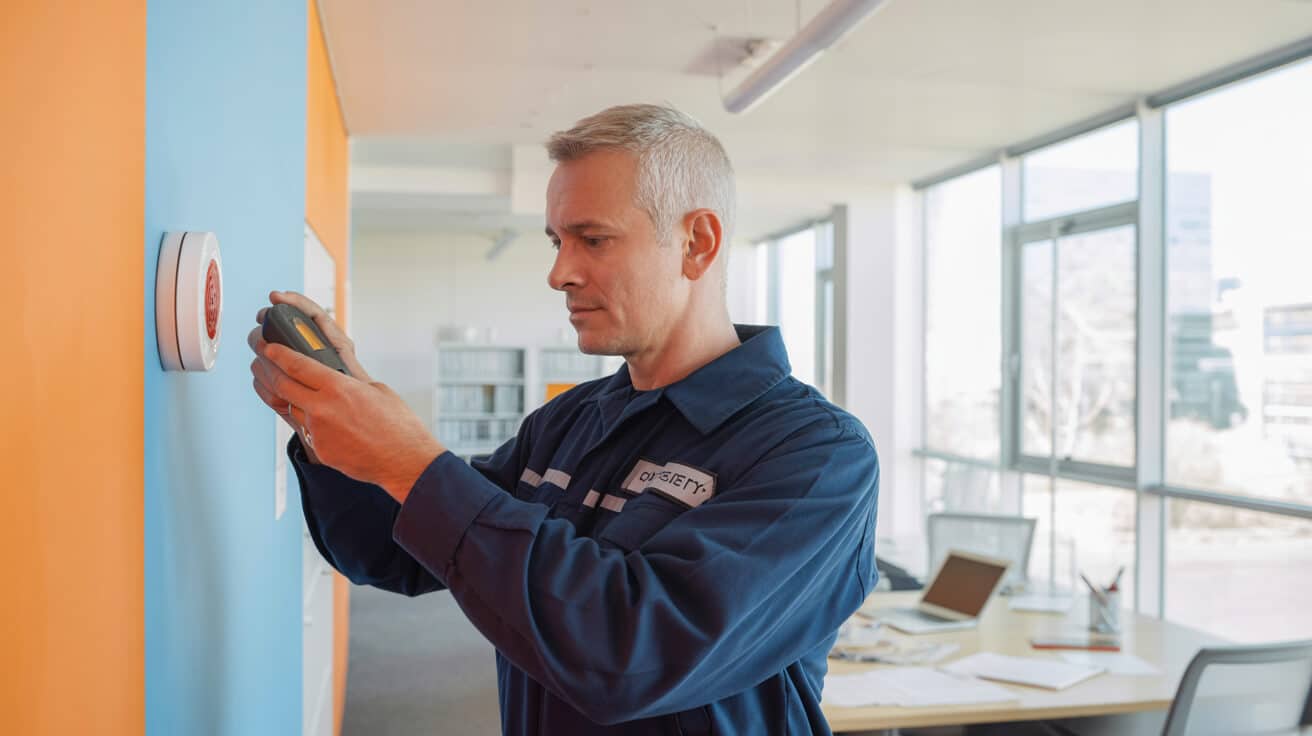
You stay on top of your responsibilities when you are clear about who is doing what, and where the boundaries sit between your team and your service provider.
Weekly user tests: on‑site staff under the Responsible Person
The weekly test is a user routine. BS 5839‑1 expects it to be carried out by the Responsible Person or someone they nominate, provided that person is instructed and competent for the task.
In practice this is often a caretaker, duty manager, receptionist, building supervisor or security officer. They do not need to be a fire alarm engineer, but they must know how to:
- operate a manual call point with a test key
- recognise normal, fire and fault indications on the panel
- silence and reset the system after the test
- make an accurate logbook entry and escalate any faults
You remain accountable even if you delegate the task, so it helps to name a primary tester and at least one deputy, with simple written instructions kept alongside the logbook.
Engineer servicing: competent fire alarm organisation
Periodic inspection and servicing must be done by a competent person or organisation – typically a fire alarm maintenance company whose engineers have suitable training, experience and access to manufacturer information.
This is where detector testing, cause‑and‑effect checks, battery capacity checks, loop and circuit tests, and deeper fault‑finding sit. Service reports should clearly state what was tested, what defects were found, what was rectified on the day and what still needs attention.
If a weekly test reveals a persistent fault, or you need to add, remove or alter devices, that is engineer territory, not a user activity.
How to run the BS 5839 weekly fire alarm test
Once you treat the weekly test as a short, scripted routine, it becomes easy for your team to repeat safely.
Before you start
You protect safety and day‑to‑day operations when you prepare properly. Before operating a manual call point you should:
- Choose a regular test time so occupants recognise the pattern.
- Tell staff and, where appropriate, residents that a test will take place.
- If the system is connected to a monitoring station, follow the procedure to place the system on test.
- Check that the panel currently shows normal status, with no uninvestigated faults or disablements.
A short pre‑test check avoids confusion and keeps confidence in the alarm.
Step‑by‑step weekly test
A typical weekly user test under BS 5839‑1 looks like this:
- Go to the chosen manual call point for that week, using a test key rather than breaking the glass.
- Operate the call point and confirm that the panel shows a fire condition in the correct zone and that the alarm sounders (and visual alarm devices if installed) operate in the areas you would expect.
- If the system is monitored, confirm with the ARC that the test signal has been received.
- At the panel, silence the alarms, then reset the system so it returns to normal.
The whole process typically takes only a few minutes once it is well rehearsed.
After the test
After the test you should immediately:
- Check that the panel has returned to normal with no new faults displayed.
- Remove any temporary “system on test” signage.
- Make a logbook entry for the test, including date, time, the call point or zone used, the result, and your name or signature.
- If anything did not work as expected, record the fault and escalate it to your service provider or internal maintenance lead the same day.
Treat the weekly test as a small but formal safety activity rather than an informal “quick try”.
Accreditations & Certifications








Manual call point rotation and zone coverage
![[ALTTOKEN]](https://allservices4u.co.uk/app/uploads/2026/01/03-Fire-Alarm-Testing-Frequency-UK-BS-5839-Weekly-Annual-Requirements.jpg)
You reduce blind spots and make audits easier when you can show that you are not just testing the same “easy” call point every week.
Why rotation matters
Guidance based on BS 5839‑1 describes using a different manual call point each week so that all call points are tested over time. The same idea applies to zones: you want to see every part of the building exercised periodically.
If you only ever test the entrance call point, devices elsewhere could hide faults for years. Planned rotation stops that happening and gives you a simple storey to tell if anyone asks how fully the system is exercised.
Simple rotation methods
You do not need complex software to achieve rotation. In most buildings you can manage it with one of these simple approaches:
- Numbered list: Number each call point on your drawings and on a simple schedule, then work through the list in order, marking each one as you test it.
- Zone‑by‑zone rota: For larger systems, rotate by zone – pick a different zone each week and use a different call point within that zone.
- Route‑based rota: For large estates, create a short walking route for each week that exercises call points in a particular part of the building or campus.
Whichever method you choose, tie it to the logbook so that, looking back over the entries, you can quickly see which points and zones have been covered, and where gaps might exist.
Fire alarm logbook: what to record every time
Your logbook is the evidence that turns “we test and service the system” into something you can demonstrate.
Core fields for weekly tests
For each weekly user test a good logbook entry will typically include:
- Date and time: of the test.
- Location and identity: of the manual call point used (for example “MCP‑03, ground floor reception, Zone 1”).
- A simple result, such as “satisfactory” or “alarms operated as expected”.
- Whether monitoring / ARC was contacted and a signal was confirmed (if the system is monitored).
- Name and signature: (or electronic equivalent) of the person who carried out the test.
This gives anyone reviewing the records a clear, chronological trail of what has actually been exercised.
Recording faults, disablements and actions
Whenever a weekly test, daily check or service visit reveals a fault, disablement or outstanding action, the logbook should show:
- what the issue is, in plain language
- when it was identified and who it was escalated to
- any interim measures in place (for example, fire patrols if a zone is disabled), and
- when and how it was resolved
Avoid broad statements such as “system fully tested” when you have only carried out a weekly call point test. Keep the logbook accurate and proportionate to the work actually done; that makes it far more useful as evidence.
Domestic vs non‑domestic: BS 5839‑1 and BS 5839‑6 frequencies
Many buildings, especially blocks of flats and HMOs, combine domestic and non‑domestic elements, so it helps to understand how the testing rhythm differs.
Non‑domestic and common parts (BS 5839‑1)
BS 5839‑1 applies to non‑domestic premises and typically to common parts of residential buildings where there is a panel‑based fire alarm system with manual call points, detectors and sounders.
For these systems the usual pattern is:
- Daily or regular visual check: of the panel for normal status.
- Weekly user test: , operating one manual call point and recording the result.
- Periodic inspection and servicing: by a competent person at intervals not exceeding six months.
- Annual coverage: of devices and functions across the year, as evidenced in service reports.
The weekly test and the six‑monthly servicing are both expected; one does not replace the other.
Domestic dwellings and HMOs (BS 5839‑6)
BS 5839‑6 applies to domestic premises, ranging from single‑family homes to flats and certain HMOs.
For most domestic alarm grades (for example Grades C, D and F), user guidance typically describes monthly testing by pressing the test button on each alarm, confirming they sound and, where interlinked, that they trigger the others.
For higher‑grade domestic systems that use a panel and detectors more like a BS 5839‑1 system (some larger HMOs and supported housing), the testing and servicing regime may look closer to the weekly / six‑monthly pattern above, with frequency considerations—much like EICR testing frequency in managed residential settings—often aligning more closely with non‑domestic routines, but still within the framework of BS 5839‑6 and the fire risk assessment.
If you manage a portfolio of blocks and HMOs, a one-page PPM schedule guide that shows which standard applies, who tests what, and how often makes questions about frequency much easier to handle.
Reliable Property Maintenance You Can Trust
From routine upkeep to urgent repairs, our certified team delivers dependable property maintenance services 24/7 across the UK. Fast response, skilled professionals, and fully insured support to keep your property running smoothly.

Get your fire alarm testing and servicing plan checked
You protect people and your organisation when your testing and servicing plan is simple to explain and easy to run. You want to be able to show, without hesitation, how often you test, who does it, when engineers attend, and what your records prove.
All Services 4U can review your current routine against BS 5839‑style expectations and your fire risk profile. You stay in control of decisions, while we check whether your weekly test method, call point rotation, logbook entries and service intervals form a coherent, defensible regime.
If you look after multiple sites, you may also want consistent templates, rotation schedules and reporting so that you can see, at a glance, which sites are on track and which need attention.
Ask for a short review of your fire alarm testing and servicing plan. Use the findings to decide what you want to change and in what order.
Frequently Asked Questions
Explore our FAQs to find answers to planned preventative maintenance questions you may have.
How often should you test and service a BS 5839 fire alarm if you want zero arguments with auditors later?
For a BS 5839‑1 fire alarm in common parts, a weekly user test and six‑monthly servicing is the pattern that keeps you aligned with the code and gives you something you can defend in front of a fire officer, loss adjuster or internal audit.
BS 5839‑1:2017 expects a weekly fire alarm test carried out by the user and periodic inspection and servicing by a competent person at intervals not exceeding six months. Over any 12‑month period, that servicing should give you full functional coverage of manual call points, detectors, interfaces, sounders and power supplies, backed by a logbook and service reports showing what was actually tested. That rhythm – weekly BS 5839‑1 fire alarm test, six‑monthly service, annual coverage – sits alongside wider life safety compliance and Testing Frequency UK requirements, and is what most Responsible Persons now use to evidence “maintenance of fire precautions” under the Regulatory Reform (Fire Safety) Order 2005.
If you are carrying a BS 5839‑1 compliance duty across multiple buildings, it is usually cleaner to lock this into a written, portfolio‑wide schedule than to keep re‑explaining the basics every time a surveyor or insurer turns up.
What a defensible BS 5839‑1 schedule looks like
- Weekly: short BS 5839‑1 weekly fire alarm test – a single manual call point, rotated methodically, panel and alarm path proved, entry in the fire alarm log book.
- Six‑monthly: competent engineer service visits, never more than six months apart, each with clear remedial actions and a dated report.
- Annually: evidence that every manual call point and key function has been exercised at least once in the last 12 months.
- Portfolio: a simple view of which buildings are on time, due or late so your Board, insurer or lender is never surprised.
All Services 4U normally starts by auditing what you already do, then fixes the pattern: we pre‑book six‑monthly BS 5839 servicing intervals a year ahead, standardise the weekly test routine, and give you a one‑page schedule per site that you can drop straight into board packs, fire risk assessment updates and renewal discussions.
Who should run the weekly fire alarm test, and where does legal responsibility actually sit?
The weekly BS 5839‑1 weekly test should be run by a trained on‑site operative, but legal responsibility stays with the Responsible Person or Accountable Person, and any gap will land back at that level if something goes wrong.
The code treats the weekly fire alarm test procedure as a user responsibility. In practice that means reception, night security, caretakers or duty managers pressing the test key on the chosen manual call point, not a fire engineer sitting there every week. They do not need to quote BS 5839‑1 clause numbers, but they must follow a consistent script: check the panel is healthy, warn occupants, test one manual call point, confirm the correct zone and audibility, reset cleanly, and log the outcome. When the test surfaces a fault, their job is to record it clearly and escalate to the person who controls fire alarm maintenance – not to improvise repairs on the panel.
If you could not, today, name who does this in each building and who checks their entries in the fire alarm log book, the risk is not “missing one test”; it is an accountability gap a regulator or loss adjuster will spot in the first ten minutes.
How to set responsibility so nothing falls between the cracks
- Allocate roles, not just names: for example, “day reception” on weekdays and “night security” on evenings and weekends.
- Issue a one‑page standard operating procedure: a simple BS 5839‑1 weekly fire alarm test checklist at the panel, in plain language.
- Give logbook ownership to one senior person: they review the book weekly and chase missed entries or faults that have sat open.
- Set simple spend thresholds: so minor call‑outs and parts can be approved quickly when tests reveal real defects.
When All Services 4U is asked to “tidy up the weekly test”, we usually spend half a day on site with your team: walk the panel, agree the script, train the testers, and send you a short governance note you can file under fire safety management – the kind of document you want in your hand when the Fire and Rescue Service or Building Safety Regulator asks how you control user testing.
How do you run a weekly BS 5839‑1 fire alarm test step by step without disrupting the whole building?
A good weekly test is short, scheduled and boringly predictable: you check the panel, warn the right people, trigger one device, prove the alarm path, reset, and log the result.
BS 5839‑1 describes the weekly test of a fire detection and fire alarm system as operating at least one manual call point, with the alarm sounders operating briefly, so you know the system can raise an alarm. In real life, the sequence is simple: confirm the panel is healthy (no active faults or unexplained disablements), warn reception and any team likely to answer calls, co‑ordinate with your alarm receiving centre if the system is monitored, then use the test key on the chosen manual call point. Watch the panel go into fire condition in the expected zone, confirm that sounders or beacons are seen or heard where they should be, confirm the signal reached monitoring if applicable, then silence, reset and make sure the panel returns to normal with no new fault lights. Finish with a clear entry in the fire alarm log book.
Done properly, the whole weekly fire alarm test procedure should take minutes and be utterly unremarkable – which is exactly how you want it when you are running a mixed portfolio with busy tenants.
Step pattern you can standardise across every building
- Before the test: check the control panel status, notify reception and other key teams, co‑ordinate with your monitoring centre if you have one.
- During the test: activate the nominated manual call point using the key, confirm the correct zone and that alarms are perceived in the right areas.
- After the test: silence, reset, confirm the panel is back to normal with no unexpected disablements, and remove any temporary isolations you used.
- Record: log date and time, manual call point ID and location, zone, monitoring confirmation where relevant, result, any fault code and your name.
All Services 4U turns that into one standard template you can roll out across your whole estate so your property maintenance teams, managing agents and duty managers are all following the same BS 5839‑1 weekly fire alarm test routine. When a fire officer, insurer or external auditor asks “show me how you prove this system works, week in, week out”, you can answer in seconds instead of apologising for five different house styles.
How should you rotate manual call points and zones so you can prove the whole BS 5839‑1 system, not just the easy bit?
If your team always uses the same convenient call point by reception, you are only proving that one cable run, not the system you will rely on during a real fire.
Under BS 5839‑1, the expectation is that over time, all manual call points are operated in the course of the weekly testing. That means putting some structure under the rota, not trusting people’s memory. The simple answer is to give each call point an ID on the zone plan (for example MCP‑01, MCP‑02), build a rotation list, and line that up with your logbook. Each weekly test uses the next ID on the list, proves the alarm path from that location, and records the ID and zone against the result. For larger or multi‑building portfolios, you can then show at a glance that every floor, stair core and riser lobby has seen a live activation within the last 12 months.
A rotation that only exists in someone’s memory usually disappears the moment that person moves on.
Rotation patterns that stand up in real audits
- Single building: list every manual call point, assign one (or a small group) to each week, and loop through the list until all are covered.
- Complex single site: group by zone or floor – week one Zone 1, week two Zone 2, and so on – then restart once the full rotation is complete.
- Multi‑building portfolio: use the same template per building, plus a summary sheet that lets you answer “when was that stair core last tested?” without digging through ring binders.
- Sensitive or event‑heavy buildings: keep high‑profile areas such as retail floors or lecture theatres on the rota, but plan their test weeks around known busy periods.
All Services 4U routinely takes as‑fitted drawings and panel data, numbers every manual call point, then builds rotation schedules and portfolio‑level views. The result is that when an insurer, lender, Building Safety Regulator or fire engineer asks “how do you know this area is not being forgotten?”, you can show a simple, date‑stamped pattern instead of relying on anecdotes.
What should a fire alarm logbook contain if you want no drama with inspectors, insurers or lenders?
A good fire alarm log book lets an outsider reconstruct exactly what happened: when you tested, what failed, what you did next, and how quickly you closed the loop.
BS 5839‑1 expects records of all inspections, tests and false alarms, and the Fire Safety Order expects you to be able to demonstrate maintenance of fire precautions. That means weekly tests recorded with date and time, the specific manual call point ID and location, zone, whether the signal reached the alarm receiving centre, the result, and who carried it out. Faults and disablements need more than “panel fault”: you should show the panel message, a plain‑language description of the issue, areas affected, any temporary risk controls, when and how it was escalated to your fire alarm contractor, and when it was closed. Service visits should record scope (“six‑monthly service, Zones 1–6”), major findings and outstanding actions with priorities, plus a pointer to the full report.
When you are dealing with a loss adjuster, regulator or in‑house audit, this is what they are looking for under fire alarm log book requirements – not optimistic statements that everything was fine with no evidence attached.
Logbook structure that stands up in claims and safety cases
- Weekly tests: date and time, manual call point ID and location, zone, outcome, monitoring confirmation where relevant, tester’s name or initials.
- Faults and disablements: panel message, clear location, affected zones, interim measures, contractor job reference, closure date and sign‑off.
- Servicing and projects: visit dates, agreed scope, notable defects, work completed on the day, and what remains outstanding after the visit.
- Attachments and references: zone plans, device lists, service reports, and in higher‑risk buildings any Safety Case evidence you expect to present to the Building Safety Regulator.
When All Services 4U is asked to repair a weak logbook, we normally do three things: re‑design the layout so it matches what regulators, insurers and lenders actually look for, backfill the last year or two from whatever reports and certificates you already hold, and then wire in a simple weekly review so the log stays clean. That is the point where you can comfortably be the person who opens a logbook in front of a fire officer or loss adjuster without tensing up.
How do BS 5839‑1 and BS 5839‑6 testing patterns work together in blocks of flats and supported housing?
In a mixed residential building, BS 5839‑1 governs the communal fire detection and alarm system, while BS 5839‑6 covers domestic smoke and heat alarms inside dwellings. Treating everything as if it were one regime is where confusion – and complaints – usually start.
For the common parts – corridors, lobbies, plant rooms and stairwells – a panel‑based system designed to BS 5839‑1:2017 should follow the pattern you already recognise: weekly BS 5839‑1 fire alarm test, six‑monthly servicing by a competent company, annual functional coverage, and a maintained logbook. Inside flats or bedrooms, the alarms fall under BS 5839‑6:2019. Those are typically standalone or interlinked domestic detectors, where either the occupier or the landlord is expected to press the test button monthly, keep vents clear, and replace units in line with manufacturer guidance and your fire risk assessment.
Registered providers, supported housing teams and HMO landlords increasingly find that the Housing Ombudsman and Regulator of Social Housing want to see these two patterns clearly separated: one regime for the communal system, another for in‑dwelling devices, each with its own testing and maintenance expectations.
Simple way to keep communal and domestic regimes clear
- Write it down in your policy: one line for “common‑parts BS 5839‑1 system” and one for “in‑dwelling BS 5839‑6 domestic alarms”, each with test frequencies.
- Map duties by area: name who runs communal weekly tests and services, and who is responsible for domestic alarms (landlord, managing agent, residents) and how you verify that.
- Use your fire risk assessment intelligently: HMOs, supported housing and high‑risk schemes may justify tighter communal routines than a straightforward general‑needs block.
- Educate residents in plain language: a short note that explains why they hear a weekly test in the corridor but are asked to press their own alarm test button monthly.
All Services 4U regularly helps RTM boards, housing associations and managing agents in this space: we review your fire strategy, map each part of the building to BS 5839‑1 or BS 5839‑6 as appropriate, then build a simple testing matrix you can show to residents, auditors and insurers so everyone understands which regime applies where – and nobody is surprised when a complaint or inspection lands.
When should you bring in a fire alarm company like All Services 4U instead of trusting that “the logbook is probably fine”?
Bring in a competent fire alarm company as soon as you cannot answer basic questions without checking three different folders: who runs the weekly tests, what your BS 5839‑1 pattern is, when the system was last serviced, and whether your evidence would support you in a serious investigation or claim.
Typical warning signs are familiar. The same manual call point has been used for weeks because “that’s the one by reception”. Service reports mostly say “all OK” but do not clearly show which zones or devices were tested. Six‑monthly visits drift closer to annual without anyone signing off the additional risk. Faults sit on the panel for days because nobody feels authorised to instruct an engineer. Or you have a Building Safety Regulator visit, insurer survey, refinance or tribunal hearing coming up and all you can put on the table is a thin fire alarm log book with patchy entries and no clear link to BS 5839‑1 weekly fire alarm test expectations or your fire risk assessment.
That is not a “bad luck” storey; it is a regime design problem – and it is exactly the kind of thing that makes responsible directors, Accountable Persons and risk partners look exposed.
Situations where outside support genuinely de‑risks your position
- You are the Responsible Person, Accountable Person or board member and would not be comfortable handing your current fire alarm records to a regulator, insurer or lender tomorrow morning.
- Weekly testing happens “most weeks” but there is no documented rotation of manual call points, no BS 5839‑1 compliant procedure on the wall, and no portfolio‑level view.
- Six‑monthly BS 5839 servicing intervals have slipped, you are unsure when different zones were last functionally tested, or recommendations from reports are not closed out.
- You are inheriting a building, or taking a block back in‑house, and need to understand in weeks – not months – how your current practice measures up against BS 5839‑1 and your fire risk assessment.
When All Services 4U is invited in, we usually start with a regime review not a hard sell: walk the panels and devices, sample your weekly test entries and service reports, benchmark them against BS 5839‑1 and the Regulatory Reform (Fire Safety) Order 2005, and then give you a clear, prioritised action plan. Some clients use that plan with their existing contractor; others ask us to standardise the whole regime – weekly scripts, rotation patterns, BS 5839 fire alarm servicing intervals, defect management, dashboards and insurer‑ready binders.
If you want to be the person in your organisation who can open any logbook, answer an auditor’s first questions in under a minute, and know that your property maintenance regime is backing you up instead of leaving you exposed, this is the point to hand the pattern to a team that lives and breathes this work every day.
- BS 5839 fire alarm testing frequency explained step by step
- Fire alarm testing in the UK: the schedule in plain English
- What BS 5839 expects: weekly tests, 6‑monthly servicing and annual coverage
- Who should carry out each type of test
- How to run the BS 5839 weekly fire alarm test
- Manual call point rotation and zone coverage
- Fire alarm logbook: what to record every time
- Domestic vs non‑domestic: BS 5839‑1 and BS 5839‑6 frequencies
- Get your fire alarm testing and servicing plan checked
- Frequently Asked Questions
- Related PPM Services
Case Studies


Related Articles

Your Guide To Identifying And Treating Minor Mould Outbreaks
Why Planned Preventative Maintenance (Ppm) Saves Money And Ensures Compliance