Fire Alarm Testing PPM Services UK – BS 5839 Weekly Tests & Annual Service
Facilities managers, landlords, and duty holders get structured UK fire alarm PPM that keeps BS 5839 weekly tests and scheduled servicing under control. A managed routine combines user test support, competent engineer visits, defect reporting, and usable records, depending on your site constraints. Compliance looks like clear logs, service reports, and follow-through on faults that stand up to auditors, insurers, and assessors. A short conversation can confirm what your current arrangement is missing and what a tighter maintenance plan would look like.



Author
Izzy Schulman

If you are responsible for a block, commercial premises, or a communal fire alarm system, missed tests and vague records can quickly turn into awkward gaps when someone asks for proof. Compliance is hard to defend if the routine is unclear or scattered across different people.

A managed fire alarm PPM service brings weekly testing, engineer servicing, defect management, and documentation into one working structure. By splitting user checks from competent servicing and tightening how visits, reports, and follow-up are handled, you stay in control of both the system and the evidence that supports your decisions.
- Weekly test routines your on-site team can actually follow
- Planned engineer servicing that does not drift overdue or forgotten
- Clear records and defect trails that stand up to scrutiny</p>
Need Help Fast?
Locked out, leak at home, or electrical issue? All Services 4 U provides 24/7 UK locksmith, plumbing, electrical.
Testimonial & Clients Who Trust Us
With 5 Star Google Reviews, Trusted Trader, Trust Pilot endorsements, and 25+ years of experience, we set industry standards for excellence. From Dominoes to Mears Group, our expertise is trusted by diverse sectors, earning us long-term partnerships and glowing testimonials.
Worcester Boilers

Glow Worm Boilers

Valliant Boilers

Baxi Boilers

Ideal Boilers

Keep Your Fire Alarm Maintenance Compliant, Visible, and Easy to Prove
You need a fire alarm routine that works in real life and stands up when somebody asks to see the proof.
If you manage common parts, non-domestic premises, or a communal system in a residential building, fire alarm PPM is not just another diary task. It is the working structure that keeps weekly checks happening, engineer servicing on time, faults tracked, and records ready when a fire risk assessor, insurer, board, or enforcing authority asks for them.
Under the usual UK approach, that means a clear split between routine user testing and competent engineer servicing. It also means recognising that a tidy certificate file is not enough on its own. You need a system that is being tested, maintained, recorded, and followed through when defects appear.
We help you turn that duty into a managed process. We help you set the routine, service the system at the right intervals, document what happened, and leave you with a clearer view of what needs action next.
If you need a fire alarm maintenance arrangement that is easier to run and easier to evidence, book a conversation now.
Know What Your Fire Alarm PPM Service Should Actually Include
A proper fire alarm PPM service combines routine checks, competent servicing, defect management, and records you can actually use.
Weekly user testing support
Your weekly test is part of day-to-day control, not a substitute for servicing. You need a routine your team can follow without guesswork, including call point rotation, panel checks, logbook entries, and a consistent testing time that reduces confusion for occupants and site staff.
Competent engineer servicing
Your engineer visits should sit on a planned schedule that does not drift beyond the expected service interval. You need more than a quick panel glance. You need inspection, testing, servicing, and a technical review of the parts of the system that can fail quietly while the building assumes everything is fine.
Faults, reports, and follow-through
A maintenance contract should not stop at “visit completed”. You need clear reporting, identified defects, practical recommendations, and a route for remedials, approvals, and close-out. That is the difference between a provider who attends and a provider who helps you stay in control.
Cheap scopes often look acceptable until you have to explain what was tested, what failed, and what happened next.
Run Weekly Tests Without Guesswork
Your weekly fire alarm test should be simple, repeatable, and easy to evidence.
Follow a basic test sequence
For typical BS 5839-1 systems, the weekly user test usually means operating one manual call point in rotation, checking that the alarm sounds, confirming the panel indicates correctly, and resetting the system properly afterwards. If the system is remotely monitored, the receiving centre should be told before and after the test so a routine check does not trigger an avoidable response.
Record what actually happened
Your logbook entry matters just as much as the test itself. You should be able to show the date, time, location or call point used, result, panel status, faults found, and the name of the person who carried out the test. If the check happened but the record is vague, incomplete, or missing, you still have an evidence problem.
Keep the routine low-friction
A weekly test is not a fire drill and it is not a full maintenance visit. Keeping that boundary clear helps your team do the right job without overcomplicating it. A regular day and time also helps occupants recognise the alarm as a planned test rather than an unexplained event, which reduces complaints without weakening discipline.
If your weekly process depends on one person who “just knows the system”, it is weaker than it looks.
Assign Responsibility Without Blurring Accountability
The legal duty stays with the Responsible Person even when tasks are delegated.
Keep accountability with the duty holder
If you control the premises, you remain responsible for making sure the fire alarm is maintained. That responsibility may sit with you as an employer, owner, landlord, managing agent, or another duty holder, depending on how control is shared. You can delegate the weekly check. You cannot delegate the accountability.
Use competent engineers for specialist work
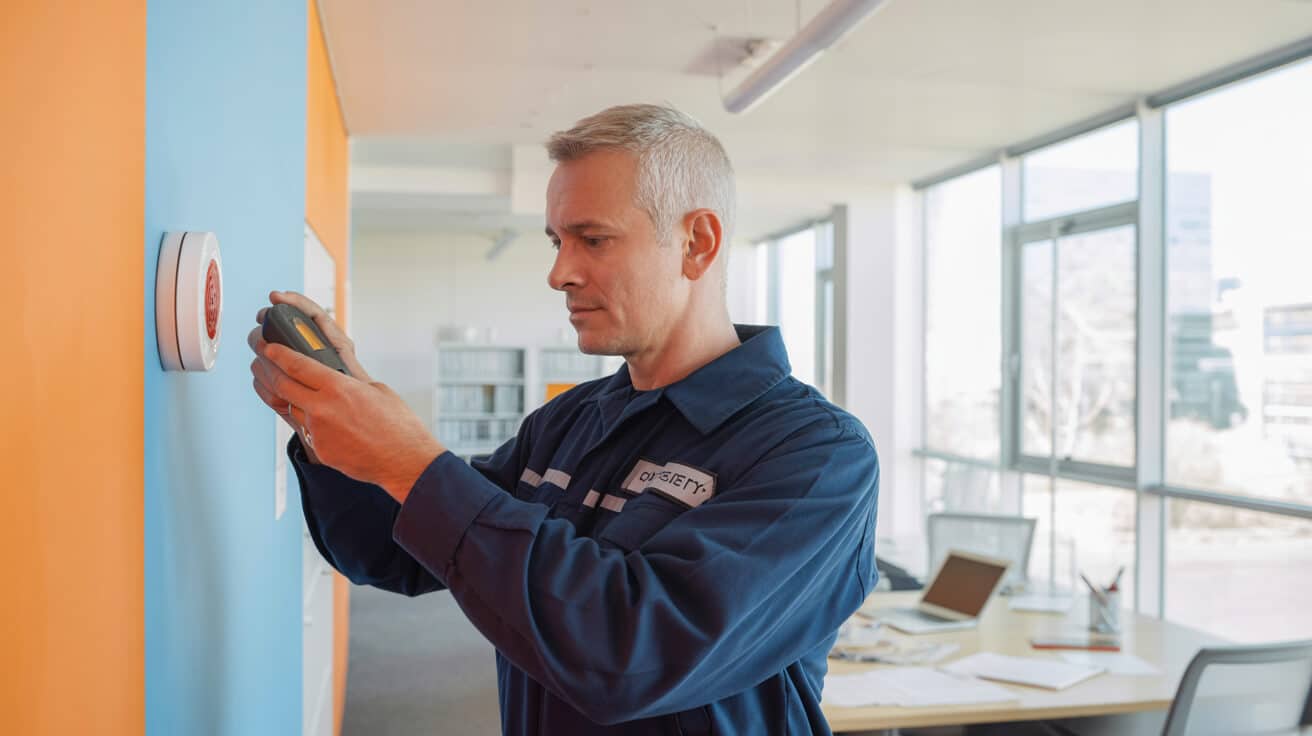
Routine user checks and technical servicing do different jobs. Your site team may be able to handle the weekly test if they are trained and the process is clear. Periodic inspection, servicing, and repair should sit with a competent engineer or service organisation that can test properly, diagnose faults, and give you evidence you can rely on.
Treat residential buildings carefully
If you manage a block, HMO, or mixed-use site, the communal fire alarm duties need to be handled like a managed building system. That avoids the common mistake of assuming private dwelling arrangements cover the whole property. The practical split is not simply “commercial versus residential”. The key line is private dwellings versus common parts and other non-domestic areas.
You need named ownership for weekly tests, engineer visits, access, and defect escalation before a missed visit exposes the gap for you.
Keep the Service Interval Under Control
For many non-domestic and communal systems, the working benchmark is weekly user testing and competent servicing at intervals not exceeding six months.
Hold the weekly rhythm
Weekly testing is the visible routine that shows the system can still raise an alarm. It also exposes missed ownership quickly. When the weekly rhythm fails, it usually points to a wider problem with control, staffing, or record discipline.
Protect the six-month service cycle
Competent inspection and servicing should not slide beyond the expected interval. In practice, many sites work to two engineer visits each year. If access problems, contractor changes, or handovers have already pushed a site overdue, recovery should be treated as a live priority, not something to leave until the next convenient slot.
If you take over a site and the last service record is already beyond the expected interval, you are not inheriting a paperwork issue alone. You are inheriting a live control gap that needs a booked visit, a clear status position, and a recovery plan you can explain.
Read “annual service” properly
In many cases, the fuller annual depth of inspection is delivered within one of the regular service visits across the year. That matters because “annual service” can sound sufficient when it is being used as shorthand. For many systems, a single once-a-year-only visit is not the right maintenance model.
If your programme has slipped, the best time to fix the schedule is before the next audit, insurer query, or contractor handover.
Expect More Than a Quick Panel Check

A competent service visit should examine the system’s condition, performance, and defects in a way weekly testing cannot.
Check the system, not just the signal
A proper visit usually covers the relevant detectors, manual call points, sounders, interfaces, control equipment, standby supplies, and batteries. The goal is not simply to make the panel show “healthy” for a moment. The goal is to confirm the system is still working as a dependable life-safety control.
Use the yearly cycle for deeper review
One visit in the annual cycle normally carries the fuller yearly inspection and test burden. That deeper review should include the record trail, false alarm history, outstanding defects, and the wider pattern of system performance. You need to know not just what passed today, but what is drifting, repeating, or being carried forward.
Turn findings into action
A weak service report leaves you with a vague status and no decision path. A strong report tells you what was tested, what failed, what remains isolated or impaired, and what remedial action should happen next. That is what helps you budget sensibly, prioritise works, and avoid repeated callouts for the same issue.
Good servicing reduces surprises. It does not simply postpone them.
Accreditations & Certifications








Keep an Audit-Ready Record Trail
Your evidence pack should show what you have, what was tested, what defects were found, and what you did about them.
Keep the weekly record clean
A weekly user test does not usually generate a separate formal certificate. The normal proof is the logbook entry itself. Paper and digital logbooks can both work, provided the record is complete and accessible to the people who need it.
Expect usable service evidence after each visit
After a service visit, you should expect inspection or servicing documentation that shows the system attended, the work completed, the areas tested, the defects found, and the actions recommended. For many non-domestic systems, inspection and servicing certificates form a key part of that evidence trail. If you only receive a short note that says “service done”, you do not have much to rely on later.
Build one joined-up compliance pack
Your records are strongest when they connect rather than sit in separate folders. A workable pack often includes:
- system details and zone information
- weekly test records and logbook entries
- fault and disablement records
- engineer service reports and certificates
- remedial actions and close-out evidence
We structure records so your weekly routine, engineer visits, defects, and close-out actions are easier to follow. You do not just get paperwork. You get a clearer chain of proof that helps with audits, insurer queries, client reporting, and management handover.
If you cannot see what was tested, what failed, and what was closed, your records are not finished yet.
Reliable Property Maintenance You Can Trust
From routine upkeep to urgent repairs, our certified team delivers dependable property maintenance services 24/7 across the UK. Fast response, skilled professionals, and fully insured support to keep your property running smoothly.

Book Your Free Consultation With All Services 4U Today
You need a clear next step if your fire alarm routine is overdue, unclear, or hard to evidence.
If your current issue is missed weekly tests, overdue servicing, repeat faults, patchy records, or confusion after a contractor or management change, bring that issue first. We will review the current position, separate user duties from engineer duties, and show you where the biggest control gaps sit.
You can use the conversation to clarify the right service cadence, the records you should already have, and the defects or backlog that need immediate attention. If you manage communal systems, mixed-use buildings, or multiple sites, we will help you sort the responsibilities and evidence trail into something more workable.
Before the meeting, gather your current logbook, recent service records, fault history, and any open remedial quotations. We will use what you already have, show you what is missing, and help you decide the fastest route back to control.
Book your free consultation with All Services 4U today.
Frequently Asked Questions
What should you do when weekly fire alarm tests have been missed or recorded badly?
You should treat missed or badly recorded weekly fire alarm tests as a control gap, then restart the routine from a verified baseline.
A missed weekly fire alarm test does not automatically mean the fire alarm system has failed. It does mean your evidence trail is weaker than it should be. In a residential block, mixed-use building, or managed communal property, that gap matters because BS 5839 Weekly fire alarm testing is not only about the alarm sounding. It is about showing that your team is actively managing the system, tracking faults, and maintaining a reliable routine in the common parts.
Under the Regulatory Reform (Fire Safety) Order 2005, fire precautions must be maintained in efficient working order. In practical terms, that means a reviewer will usually want to see more than a panel that appears healthy on the day. They will want to see a pattern of consistent checks, sensible ownership, and readable records. If the logbook is patchy, the weakness is not just administrative. It affects how confidently you can explain the building’s fire alarm maintenance position to a fire risk assessor, insurer, board, or client.
Poor records usually start as an ownership lapse long before they become a compliance problem.
The good news is that most missed-test situations are recoverable without drama. What matters is how you respond. The strongest response is calm, factual, and honest. You identify the gap, confirm the present condition, restart the routine properly, and make future ownership unmistakable. That is far easier to defend than trying to tidy the past after the fact.
If your property maintenance model already feels stretched, this is also a sensible point to tighten your wider fire alarm maintenance process, not just the weekly entry. A clean restart usually works best when the weekly user test, the service schedule, the defect tracker, and the compliance binder all line up.
What should you check first before restarting weekly fire alarm testing?
You should first confirm the last reliable evidence point, the current panel condition, and who owns the task now.
Start with facts you can verify today. Check the last clearly dated weekly user test entry. Check the latest service report and whether periodic servicing is current. Look at the control panel for any active faults, disablements, or historic trouble indications. Confirm whether the building has a named person responsible for weekly testing and whether there is a deputy if that person is absent.
That review gives you a baseline. Without it, you are working from assumptions. In communal residential buildings and mixed-use sites, assumptions are usually where the problem began. A managing agent changes, a caretaker leaves, a concierge rota shifts, or a contractor handover happens. The weekly task does not fail because the instruction disappeared. It fails because ownership became vague.
A sensible first-pass recovery review should cover:
- the last dependable weekly fire alarm test record
- the most recent service certificate or engineer report
- any open panel fault, disablement, or isolation
- the current on-site owner of the test
- the format and location of the logbook
- whether the fire risk assessment refers to the alarm regime clearly
If the six-monthly service interval has slipped as well, the problem is wider than weekly discipline alone. That points to a maintenance control issue, not just a logbook issue. BS 5839-1 is the recognised benchmark commonly used for non-domestic and communal fire alarm system maintenance, so your review should compare the actual position against that expectation rather than against local habit.
Why is it risky to backfill missed weekly fire alarm records from memory?
It is risky because guessed entries weaken credibility more than an honest gap followed by a clean reset.
When records are already weak, the temptation is to make the logbook look tidy. That is usually the wrong move. If several weekly tests were missed during a staffing change, holiday period, or contract mobilisation, recreating them from memory turns an ordinary procedural lapse into a trust problem. A reviewer can usually live with an honest gap and a well-managed recovery. They will be much less comfortable with entries that appear reconstructed after the event.
A stronger recovery note usually records:
- when the lapse was identified
- what current checks were carried out
- whether the panel showed faults or disablements
- when the routine was restarted
- who now owns the weekly fire alarm testing process
- what control has been added to stop recurrence
That is easier to explain because it shows judgement. It also aligns better with the wider principle in Home Office fire safety guidance that maintenance records should help demonstrate effective management, not simply fill space in a book.
There is a difference between a building with a record gap and a building that appears to be disguising one. The second problem is always harder to defend.
How should you reset the routine so the same problem does not happen again?
You should reset the routine with named ownership, a fixed test day, a backup owner, and a simple review trail.
This is where many buildings either recover properly or drift back into the same pattern. A restart is not just writing the next entry. It is putting a repeatable control back in place. In practice, that usually means assigning one named weekly owner, one fallback owner, one fixed day, and one storage location for records that does not depend on memory.
A stronger reset often includes:
| Control point | Weak setup | Strong setup |
|---|---|---|
| Ownership | “Site team handles it” | One named person and one deputy |
| Timing | Ad hoc during the week | Fixed weekly test day |
| Recording | Loose paper or email trail | Single logbook or managed digital record |
| Review | Only checked after a problem | Monthly spot-check by manager or board representative |
That structure matters to RTM boards, managing agents, and compliance leads because it turns a fragile routine into something you can oversee. It also helps if the property is ever challenged on fire alarm maintenance discipline by an auditor, resident representative, or insurer.
If you want to stabilise the process quickly, the practical next step is usually a short fire alarm record review, a restart note, and a weekly ownership map. That gives your team a cleaner position this week, not just a better intention for next month. Where All Services 4U is useful is in making that reset concrete: clarifying the weekly test routine, checking service currency, setting up the defect tracker, and giving you a more audit-ready file instead of another informal workaround.
What does a stronger recovery position look like after the gap has been found?
A stronger recovery position means you can explain the gap, the current status, and the future routine without hesitation.
That is the real test. If a board member, insurer surveyor, or fire risk assessor asks what happened, you should be able to answer in a straight line. You identified the lapse. You checked the current condition of the fire alarm system. You confirmed servicing status. You restarted weekly fire alarm testing from a known date. You assigned ownership. You put a review point in place.
That kind of answer signals control. It also protects reputation. Property teams are judged less by whether nothing ever slips and more by whether they recover cleanly when something does. In a building safety context, that distinction matters. Calm recovery beats cosmetic perfection every time.
If your present records would not support that conversation comfortably, that is usually a sign to tighten the fire alarm maintenance routine now rather than later. The teams that look strongest under scrutiny are rarely the ones with flawless history. They are the ones with a defensible system today.
Which buildings usually need weekly fire alarm testing and six-monthly servicing?
Buildings with managed communal or non-domestic fire alarm systems usually need weekly testing and servicing that does not drift beyond six months.
That includes many residential blocks with communal systems, mixed-use developments, offices, schools, HMOs, and shared buildings where a fire alarm panel protects common parts or non-domestic areas. The confusion usually comes from labels. Teams hear “residential” and assume the same maintenance logic applies everywhere. It does not. A private flat with domestic smoke alarms is not managed the same way as a block with a communal fire alarm system serving corridors, stair cores, plant spaces, or shared escape routes.
The practical question is not what the building is called. It is what the system protects and who is responsible for managing it. Once a communal or non-domestic system is in play, a formal routine is usually expected. That means BS 5839 Weekly fire alarm testing by the user and periodic servicing by a competent engineer, commonly aligned to BS 5839-1 for communal and non-domestic systems.
This distinction matters because misclassification creates avoidable exposure. A building may look straightforward on paper and still have a much more demanding management duty in reality. Home Office guidance on purpose-built blocks of flats has long made the communal-versus-domestic distinction important. If the system is there to protect shared spaces under active management, your fire alarm maintenance process needs to reflect that.
The label on the building matters less than the spaces the system is actually protecting.
For property owners, RTM directors, and managing agents, this is often where unnecessary risk begins. Not with a failure of hardware, but with a mistaken assumption about which maintenance standard applies.
Which building features usually point to a formal fire alarm maintenance routine?
A formal routine is usually needed where there is a communal panel, common parts, or managed non-domestic coverage.
You can often spot the answer by walking the building and asking a few plain questions. Is there a control panel serving shared areas? Do common parts rely on the system? Are there linked detectors outside private demise areas? Is there a mixed-use interface between residential and commercial spaces? If yes, the building is usually closer to a managed communal fire alarm model than a purely domestic one.
A simple rule-of-thumb check looks like this:
| Building feature | Why it matters | What it usually points to |
|---|---|---|
| Communal fire alarm panel | Shared life-safety control | Weekly user tests and engineer servicing |
| Common parts in a block | Managed escape routes and shared spaces | Formal logging and maintenance records |
| Non-domestic occupancy | Duty-holder responsibility applies | Structured servicing routine |
| Mixed-use layout | Interfaces increase management complexity | Clear scope and ownership map |
That does not remove the need to review the actual design and fire strategy. It does give you a practical starting point. In many buildings, uncertainty disappears once you stop debating the label and start mapping the protected areas and managed responsibilities.
Why do teams so often get the scope wrong?
They often focus on occupancy labels instead of system function and management responsibility.
That mistake is common during handovers, acquisitions, and mobilisations. A site is described as “mainly residential,” so the shared alarm arrangements are treated too casually. Or a commercial unit is considered separate, even though the alarm interfaces with shared escape routes or common infrastructure. The building then ends up with a maintenance routine that does not match the operational reality.
Typical signs of wrong scoping include:
- weekly tests treated as optional or informal
- six-monthly servicing drifting beyond target intervals
- common parts omitted from the maintenance story
- uncertainty over who owns the logbook
- audit or insurer queries that take too long to answer
For a managing agent or compliance lead, this creates avoidable friction with boards and residents. For a lender or valuer, it can raise broader questions about how robustly the building is being managed. For an insurer, it can point to weak risk discipline around the fire alarm system.
Where is the practical line between domestic alarms and communal fire alarm systems?
The practical line is usually whether the system protects only private living space or also managed shared areas.
That sounds simple, but it is exactly where many properties get muddled. A flat with self-contained domestic alarms is one thing. A block with communal detection or a shared panel across corridors, risers, or plant rooms is another. The maintenance expectations differ because the management responsibilities differ.
A useful boundary test is this:
- if the system is confined to one private dwelling, the routine is usually domestic in nature
- if the system serves shared spaces, managed escape routes, or non-domestic areas, the routine usually becomes formal
- if the building is mixed-use, the safe approach is to map the interfaces clearly instead of assuming separation
That boundary matters commercially as well as operationally. The wrong classification can lead to under-servicing, poor records, and later remedial cost. It can also undermine confidence in your wider property maintenance programme because the building appears uncertain about a basic life-safety control.
How should you respond if the current classification looks shaky?
You should review the system purpose, the managed areas, and the maintenance routine before the next challenge forces the issue.
This does not need to become a technical essay. In many buildings, a short review of the panel arrangement, zone coverage, communal interfaces, and service history is enough to confirm whether the current fire alarm maintenance routine is proportionate. If the building has inherited ambiguity after a mobilisation, agent change, or portfolio transfer, that review becomes even more useful.
A strong outcome from that review usually gives you three things: a clearer scope, a clearer owner, and a clearer servicing expectation. Those three points are what most stakeholders are looking for anyway. Boards want reassurance. Managing agents want operational certainty. Insurers want disciplined control. Lenders want a management picture that does not look improvised.
If your team is still relying on building labels rather than system purpose, now is a good time to correct that before it turns into a service issue or a credibility issue. All Services 4U can help map the communal fire alarm system, the managed areas, and the practical maintenance expectations into a simpler operating routine, so your answer is based on evidence rather than assumption.
How can you tell when a fire alarm maintenance contractor is only doing the minimum?
You can usually tell when the contractor produces attendance and certificates, but not enough clarity to help you manage the system properly.
That is the difference between activity and control. A contractor doing the minimum may attend on time, touch the panel, issue a certificate, and still leave you with weak understanding of what was checked, what remains open, and what needs to happen next. On paper, the visit exists. Operationally, your team is still carrying the uncertainty.
This matters because a fire alarm maintenance contract should reduce management burden, not quietly shift it back onto the client. If your property team has to chase every defect explanation, reconstruct fault history from scattered notes, or interpret vague service language before anyone can make a decision, the contract is probably underperforming. Competence signals such as third-party certification can help you shortlist providers, but paperwork alone does not guarantee useful reporting or disciplined follow-through.
The stronger question is not “Did they attend?” It is “Can you explain the current status of the fire alarm system more clearly after they left?”
If the answer is no, the contractor may be servicing to minimum output rather than supporting your compliance position.
What usually gives weak fire alarm maintenance contractors away?
Weak contractors usually leave vague reporting, repeat faults, and unclear close-out behind them.
The signs are often subtle at first. A report says “service completed” but gives little technical detail. A recurring panel fault appears across several visits with no convincing root-cause explanation. Advisory items and urgent defects are not clearly separated. Access issues are mentioned, but there is no recovery plan. Certificates appear without any practical tracker showing what still needs action.
A weak-output pattern often looks like this:
| Weak contractor output | Strong contractor output | What it means for you |
|---|---|---|
| Generic visit notes | Specific findings and affected devices or zones | Better operational decisions |
| Repeat faults with no diagnosis | Fault trend visibility and likely cause | Faster close-out |
| No defect grading | Clear priority and recommended action | Easier risk management |
| Certificate only | Certificate plus action tracker | Better audit readiness |
This is where cost starts doubling back on you. You pay once for the service visit, then again in staff time, confusion, resident disruption, and repeat contractor attendance.
Which comparison questions reveal service quality faster than price?
The best comparison questions are about proof, prioritisation, and close-out support, not just attendance frequency.
Price matters, but it is a blunt instrument. Two contractors can quote similar servicing terms while delivering very different management value. A stronger comparison conversation asks to see sample reports, sample defect trackers, and the contractor’s method for separating routine maintenance from remedial recommendations.
Good questions include:
- What does your service report look like after a typical visit?
- How do you grade and track defects?
- How do you show repeat faults over time?
- How do you support weekly fire alarm testing discipline on site?
- What close-out evidence do you provide after remedials?
Those questions expose quality quickly. A confident provider can usually answer with specifics. A weak provider often circles back to “industry standard servicing” without showing how that actually helps a managing agent, board, or compliance lead run the building.
Why do poor contractors sometimes look acceptable for too long?
They can look acceptable because certificates create the impression of control even when reporting quality is weak.
That is especially common across portfolios. One site has a tidy record set, another has thin paperwork, and nobody can explain the difference because the contractor’s output is inconsistent. The risk is not only technical. It is reputational and managerial. When a board, insurer, or auditor asks for a clear story, your team is left defending paperwork that does not really do its job.
This is why report quality matters almost as much as engineering competence. A good service partner gives you decision-ready information. A weak one gives you attendance evidence and leaves the interpretation burden with you.
For higher-accountability settings, such as RTM boards, housing associations, and mixed-use developments, that distinction becomes more visible. Weak contractor output tends to create slower decisions, slower remedials, and more friction across teams.
How should you decide whether to review, reset, or replace the contractor?
You should review the contractor when reporting is weak, reset the scope when expectations are unclear, and replace them when repeat failures continue.
A one-off weak report does not always justify a full contractor change. Sometimes the issue is scope definition or reporting format. In those cases, a reset may be enough. Set clearer reporting expectations, require defect grading, and ask for visible close-out tracking. If the contractor adapts, the relationship may still be workable.
A wider review is justified when:
- repeat faults keep returning without explanation
- service visits produce little actionable detail
- remedial items remain open for too long
- portfolio reporting is inconsistent
- your team spends too much time translating their output
Replacement becomes more likely when the same concerns survive the review. At that point, the problem is not just style. It is capability or discipline.
If you are carrying the accountability, a contractor review matrix is often the safest next step. That lets you compare report quality, defect clarity, trend visibility, communication, and close-out support before the next renewal or incident puts you under pressure. All Services 4U can help structure that review so you can draw a cleaner line between basic attendance and genuinely useful fire alarm compliance support.
Why do false alarms keep happening even when the system is being serviced?
False alarms keep happening when the recurring cause has not been properly diagnosed, corrected, or tracked to closure.
A fire alarm system can be serviced and still create nuisance alarms if the real trigger remains in place. Routine servicing confirms the system is being maintained. It does not automatically solve repeat activations caused by contamination, steam, dust, aerosols, cooking emissions, poor detector siting, environmental conditions, interface faults, or ageing devices. If nobody joins those signals together, the building ends up with a serviced system that still behaves unreliably.
That matters because nuisance alarms are not only disruptive. They weaken confidence. Residents get frustrated. Staff start assuming the next alarm is another false call. Boards begin asking why they are paying for maintenance without seeing improvement. In communal residential and mixed-use buildings, repeated false alarms also create a reputational problem because they suggest a lack of grip over the fire alarm maintenance regime.
The Fire Industry Association and wider sector guidance on false alarm reduction both point to the importance of identifying and managing cause patterns rather than simply resetting the system each time. A repeat activation is usually telling you something. The risk grows when the building treats the event as noise rather than evidence.
Servicing proves presence. Diagnosis proves control.
That is the real distinction. If the same zone, device, or site condition keeps triggering events, the question is no longer whether the engineer attended. It is whether the root cause has been understood and closed.
What should a useful false alarm report tell you?
A useful report should identify the recurring trigger, explain the likely cause, and state what action is needed next.
If a false alarm report only confirms that the system was reset, it has limited management value. A stronger report should show the zone or device involved, the likely trigger category, whether the cause appears environmental or technical, and whether remedial action is now required. It should also tell you whether a recommendation has been completed or simply noted.
A useful report will usually help you answer:
- which zone or device was involved
- whether the same trigger has appeared before
- whether the cause looks environmental, behavioural, or technical
- whether the detector type or location remains suitable
- whether remedial work has been raised and closed
Without those points, your team is left paying for attendance without getting better system reliability.
Which patterns suggest you have a diagnosis problem, not just a nuisance problem?
You have a diagnosis problem when the same issue repeats and nobody can explain why with confidence.
That often shows up in a familiar cycle. A resident reports a false alarm. The system is reset. A service visit happens. The file looks active. Then the same zone activates again a few weeks later. At that point, the building is no longer dealing with isolated bad luck. It is dealing with an unresolved pattern.
Common pattern indicators include:
- repeated activations in the same zone
- the same detector appearing in multiple reports
- false alarms during specific weather or occupancy conditions
- vague references to “no fault found”
- recommendations that are recorded but not completed
Many sites tolerate that pattern for too long because they assume older systems simply behave that way. Sometimes age is part of the issue. Often it is not. Detector suitability, environmental contamination, or local operating practice can be just as important.
How should you move from repeated false alarms to practical control?
You should move through a simple sequence of pattern review, diagnosis, remedial action, and re-test.
That matters because repeated false alarms are often managed too loosely. The building keeps responding to events, but the events are not being turned into a structured improvement process. A better model is straightforward.
| Step | What you review | What you decide |
|---|---|---|
| Pattern check | Recent false alarm history | Random event or repeat issue |
| Diagnosis | Zone, device, environment, behaviour | Likely root cause |
| Remedial action | Detector change, relocation, housekeeping, technical fix | What must be done |
| Re-test and trend review | Post-fix event history | Whether the issue is actually closed |
This gives you a cleaner route from disruption to resolution. It also gives boards and compliance leads a far more credible explanation than “the engineer attended again.”
When do repeat false alarms justify a broader contractor or system review?
They justify a broader review when recurring activations survive ordinary servicing and local remedials.
If the same nuisance pattern remains visible after reasonable remedial action, the issue may no longer sit with one detector or one isolated site condition. It may point to reporting weakness, poor contractor diagnosis, system ageing, or a mismatch between the current environment and the original fire alarm design assumptions.
That does not automatically mean replacement. It does mean the site should stop treating the issue as routine noise. A structured review of recent service reports, false alarm records, outstanding recommendations, and any repeated zone history usually tells you whether the next step is targeted remedials, a contractor reset, or a wider fire alarm system review.
For property teams, that review protects confidence before the building slips into habitual mistrust of its own alarm system. For resident-facing teams, it reduces frustration. For boards and insurers, it shows the issue is being managed as a reliability problem with evidence, not as a recurring inconvenience with excuses.
If your current reporting still makes false alarms feel random when they are clearly not, this is usually the point to sharpen the process. All Services 4U can help review the event history, isolate the recurring pattern, and turn repeat false alarms into a proper remedial and reporting plan rather than another loop of avoidable disruption.
When should you move from routine maintenance into remedial works or a wider review?
You should move beyond routine maintenance when the fire alarm system stays technically active but the control picture becomes harder to defend.
That is the point many buildings miss. Routine servicing is meant to maintain a healthy system. It is not meant to carry unresolved defects, unclear records, or recurring uncertainty indefinitely. Once faults repeat across visits, logbook quality stays weak, zones remain isolated, or the same remedials keep drifting without closure, you are no longer dealing with ordinary fire alarm maintenance. You are managing accumulating risk and incomplete control.
The warning signs are often quieter than people expect. There may be no dramatic system failure. Instead, simple questions become hard to answer. Which defects are still open? How old are they? Are weekly fire alarm testing records reliable? Is the current contractor diagnosing issues properly? Has the building’s use changed enough to justify a wider system review?
When those questions stop producing simple answers, the routine maintenance model is usually no longer enough.
For RTM boards, compliance leads, and accountable building teams, this matters because uncertainty tends to become more expensive over time. The next cost may not be a major fault. It may be resident frustration, an insurer query, a board challenge, or a remedial package that could have been smaller if it had been addressed earlier.
Which patterns usually show routine servicing is no longer enough?
Routine servicing is usually no longer enough when repeat weakness starts outweighing clear closure.
The most common triggers are not dramatic failures. They are repeated management symptoms that show the maintenance regime is not converting attendance into control.
Common escalation signals include:
- overdue servicing with no firm recovery date
- repeat faults across several visits
- devices or zones left isolated
- patchy weekly testing after staff or contractor change
- repeated false alarms with no convincing diagnosis
- defects raised more than once without clear closure evidence
A single defect does not automatically justify wider escalation. A pattern does. Once the same weakness reappears across time, the question becomes whether the issue is technical, procedural, contractual, or strategic.
How can you tell whether the problem is scope, contractor quality, ownership, or system condition?
You can usually tell by reviewing who owns the issue, how clearly it is reported, and whether the same cause keeps reappearing.
This is where a calm diagnostic ladder helps. Not every escalation point means the system needs replacing. Some issues sit with ownership. Weekly fire alarm testing may be unclear after a mobilisation. Some sit with reporting. The contractor may be servicing without giving usable defect intelligence. Some sit with scope. The maintenance contract may not reflect the actual building risk. Others genuinely sit with system condition, where ageing devices or inherited layouts now need more than routine servicing.
A useful review asks four questions:
| Review question | If the answer is weak | What it may point to |
|---|---|---|
| Who owns weekly and remedial follow-through? | Nobody clearly does | Site ownership problem |
| Are reports specific and prioritised? | No | Contractor quality problem |
| Does the service scope fit the building risk? | Not clearly | Scope problem |
| Do issues recur despite clear follow-through? | Yes | System condition problem |
That framework helps prevent overreaction. It also prevents drift. You do not need to leap to full replacement just because the file feels uncomfortable. You do need to identify which layer is actually failing.
What does a sensible escalation path look like?
A sensible escalation path starts with structured review, then moves to targeted remedials, contractor reset, or wider system review as needed.
In many buildings, the first useful step is not a major works package. It is a controlled review of maintenance history, defect age, servicing quality, weekly record reliability, false alarm trends, and ownership structure. That review often shows whether the building needs a small corrective action or a larger decision.
A calm escalation path usually looks like this:
- confirm current servicing and weekly testing status
- age and grade open defects
- review repeat fault and false alarm history
- test whether reporting is decision-ready
- decide whether the weakness sits with ownership, scope, contractor, or system condition
That is a stronger decision route than jumping straight from frustration to replacement. It creates evidence for the next move rather than a reaction.
Why does timely escalation matter commercially as well as technically?
It matters because unresolved uncertainty is what turns manageable defects into expensive programmes.
A defect that stays open too long can become a wider confidence problem. A recurring isolation can affect how the fire alarm system is perceived in the next audit. A vague service history can complicate insurer discussions. A growing list of small open items can make a future tender more difficult because nobody can clearly separate condition issues from reporting issues.
The best time to escalate is usually before the system forces the conversation. That does not mean acting dramatically. It means acting early enough that the next step is proportionate, evidenced, and easier to fund or approve.
If your current maintenance story is beginning to feel harder to explain than the system itself, that is often the signal. A structured fire alarm review with All Services 4U can help you clarify whether the building needs targeted remedials, a contractor reset, or a wider system review, while keeping the next decision practical and defensible rather than reactive.
How do you prepare for an audit, insurer question, or client review about your fire alarm records?
You prepare by turning scattered fire alarm records into one readable sequence of testing, faults, actions, and closure.
Most reviews do not fail because no work happened. They fail because the evidence is fragmented. Weekly fire alarm testing may be in one logbook. Service certificates may sit in another folder. Fault emails may live in inboxes. Remedial quotations may exist, but not beside the close-out evidence. A board pack may mention an issue without showing whether it was resolved. When that happens, the building can look less controlled than it really is.
Home Office guidance places clear weight on maintenance and record keeping as part of demonstrating that fire precautions are properly maintained. In practice, that means your records need to do more than exist. They need to connect. A reviewer should be able to see what was tested, what was found, what was fixed, what remains open, and who owns the next step.
That applies differently depending on who is asking the question. A board usually wants confidence and clear risk status. An insurer usually wants evidence that conditions precedent and management controls are being met. A client reviewer or auditor usually wants consistency, traceability, and ownership. The same records can satisfy all three, but only if they are organised properly.
An audit-ready file is not a bigger folder. It is a clearer story.
That is the practical standard. If the story is easy to follow, scrutiny usually feels lighter. If the story is fragmented, even good work can look weak.
What should be in an audit-ready fire alarm file?
An audit-ready fire alarm file should show the routine, the service history, the defect picture, and the close-out trail in order.
At minimum, you should be able to assemble:
- recent weekly fire alarm testing records
- latest service reports and certificates
- panel fault or disablement history where available
- remedial quotations and completion evidence
- open defect tracker with dates and status
- basic system reference details, such as zone plans or device schedules if held
The sequence matters as much as the content. A reviewer should not have to hunt across site folders, contractor emails, and separate spreadsheets to understand the current position. If your property maintenance records force that kind of reconstruction, the review will feel harder than it needs to.
A stronger file structure often works in this order:
| File section | What it should show | Why it matters |
|---|---|---|
| Routine testing | Weekly user checks | Confirms discipline on site |
| Servicing | Six-monthly or programmed maintenance evidence | Confirms formal maintenance is current |
| Faults and defects | What was found and what remains open | Shows the real system picture |
| Remedial closure | What was done and when | Proves follow-through |
That structure is usually enough to calm most early-stage scrutiny because it replaces fragmentation with continuity.
What are insurers, clients, and boards quietly testing besides the paperwork itself?
They are usually testing currency, ownership, consistency, and whether open issues are actually being managed.
That is why a fire alarm file should not feel like an archive. It should feel like an active management tool. The reviewer wants to know whether weekly fire alarm testing is regular, whether servicing is current, whether faults are visible, and whether defects move to closure. If those points are easy to show, the building appears controlled. If they are hidden across disconnected records, the same building can appear uncertain.
A board will often care most about this:
- are life-safety controls being checked regularly
- are open issues visible and ageing properly
- who owns the next action
- does the current position create immediate risk or governance concern
An insurer or broker may care more about this:
- are maintenance routines current
- are fault and impairment periods visible
- is there evidence of active management rather than passive filing
- can the building support its position quickly if queried
A client reviewer or auditor may focus on:
- sequence and traceability
- document consistency
- status clarity
- whether the same issue appears unresolved across multiple records
Which mistakes make a fire alarm record set look weaker than it should?
The biggest mistakes are fragmentation, unclear status, and evidence that exists without being linked.
Many files look weaker than they really are because the underlying documents are not brought together properly. The service certificate exists, but the open defect list is elsewhere. The weekly log is complete, but nobody has linked it to the remedial close-out. The building has a good story, but the file does not tell it.
Common mistakes include:
- storing weekly tests separately from service reports
- keeping remedial evidence in email only
- listing defects without ageing or status
- leaving weekly testing ownership unclear
- failing to show what changed after a fault or service finding
These are not glamorous fixes, but they are powerful ones. Small improvements in file order often have more impact than adding more documents.
How do you move from scattered records to a review-ready compliance pack?
You move by indexing the record set, reconnecting the sequence, and making ownership visible before the next review arrives.
That usually means one indexed file structure, one open-actions view, one clear ownership line, and one review rhythm. You do not need to create a mountain of new paperwork. You need to make the existing fire alarm maintenance evidence easier to follow.
A strong next step this week is often to build or refresh a simple compliance pack containing the latest weekly testing trail, latest service evidence, open defects, closed defects, and current owner. That gives you a steadier answer for boards, insurers, and auditors without waiting for the next problem to expose the gaps.
The strongest property teams are rarely the ones with the thickest binders. They are the ones whose records answer practical questions without drama. If that is the standard you want your building to meet, All Services 4U can help turn scattered fire alarm records into a cleaner compliance pack, a clearer defect tracker, and a more dependable review file that supports your position when scrutiny arrives.
- Keep Your Fire Alarm Maintenance Compliant, Visible, and Easy to Prove
- Know What Your Fire Alarm PPM Service Should Actually Include
- Run Weekly Tests Without Guesswork
- Assign Responsibility Without Blurring Accountability
- Keep the Service Interval Under Control
- Expect More Than a Quick Panel Check
- Keep an Audit-Ready Record Trail
- Book Your Free Consultation With All Services 4U Today
- Frequently Asked Questions
- Related PPM Services
Case Studies


Related Articles

Your Guide To Identifying And Treating Minor Mould Outbreaks
Why Planned Preventative Maintenance (Ppm) Saves Money And Ensures Compliance